


Spain is generally a very safe country to visit, but knowing what to do when something goes wrong can make a huge difference when you’re thousands of miles from home.
After living in Madrid for seven years, I can tell you that I’ve always felt comfortable getting around Spain. But safe doesn’t mean nothing ever happens. Pickpocketing, lost passports, medical problems, extreme summer heat, transportation disruptions, and other unexpected situations can turn up on any trip.
And dealing with an emergency is a lot harder when you’re jet-lagged, don’t speak Spanish, and suddenly realize you have no idea what number to call.
The good news? Spain has excellent infrastructure, widely available medical care, and a national emergency number that works throughout the country.
Here’s the safety and emergency advice in Spain I recommend knowing before you leave.
This post may contain affiliate links, which means I may earn a small commission if you book or purchase through one of my links, at no extra cost to you. Think of it as helping fund my next café con leche while I keep bringing you more Spain travel tips. ¡Gracias!
Is Spain Safe for Tourists?
Yes. Spain is generally considered a safe destination for international travelers.
Spain’s official tourism website describes the country as one of the safest in the world, while still recommending normal precautions against theft, particularly in crowded areas and on public transportation.
For most tourists, the more realistic concerns are everyday travel problems rather than serious violent crime.
Think:
- Pickpocketing
- Phone or wallet theft
- Lost passports
- Heat-related illness
- Minor injuries
- Getting separated from your group
- Transportation problems
- Scams in heavily touristed areas
You don’t need to spend your trip looking over your shoulder. You do want to travel smart.
Learn more about current U.S. advisory level and safety guidance.
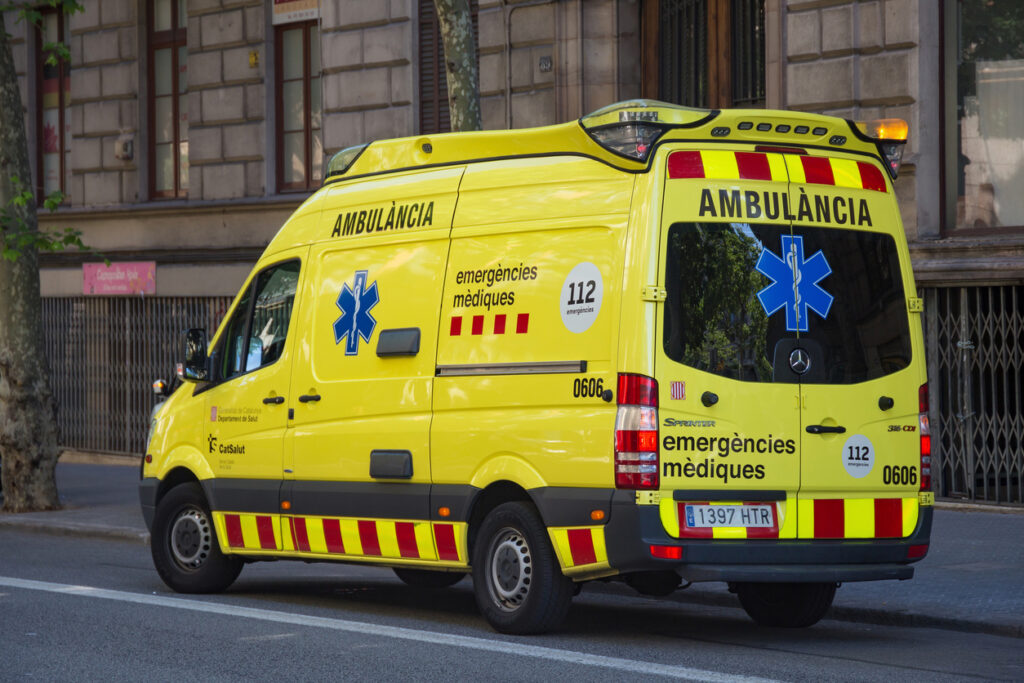
The Most Important Emergency Number in Spain: 112
If you remember only one number from this article, make it:
112
This is Spain’s general emergency number and works throughout the country.
Call 112 when you need urgent assistance from emergency services, including police, firefighters, or medical services.
The call is free, and Spain’s official tourism authority says the service can locate the caller and offers tele-translation in multiple languages.
It’s the European equivalent of calling 911 in the United States.
Save 112 in your phone before your trip. Better yet, make sure everyone traveling with you knows it.
What Should You Do During an Emergency in Spain?
If you’re facing an immediate threat to your safety or a serious medical emergency, call 112.
Try to remain where emergency responders can find you unless staying there would put you in danger.
When calling, be prepared to explain:
Where you are. Give the street, building, hotel, Metro station, landmark, beach, restaurant, or other identifying information.
What happened. Explain whether you need medical assistance, police, firefighters, or another emergency service.
Who needs help. Tell them how many people are involved and whether anyone is injured.
Don’t worry if your Spanish disappears the second you’re stressed. Spain’s 112 service has multilingual assistance available.
A few Spanish words can still be useful:
Ayuda = Help
Emergencia = Emergency
Policía = Police
Ambulancia = Ambulance
Hospital = Hospital
Necesito ayuda = I need help
Llame a una ambulancia = Call an ambulance
Get help from the US Embassy here.
What to Do If You Need Medical Care in Spain
Spain has a well-developed healthcare system, and good medical care is widely available. The U.S. State Department notes that travelers can generally obtain medical assistance throughout the country, although response times may be longer in smaller communities.
For a life-threatening emergency, call 112.
For a non-emergency illness or injury, your options may include a pharmacy, local health center, urgent care facility, private clinic, or hospital.
And don’t underestimate Spanish pharmacies.
You’ll recognize them by the illuminated green cross and the word farmacia.
Pharmacists can be incredibly helpful for minor health concerns and can often advise you whether you need to see a doctor.
It’s also a good reason to have travel insurance that includes medical coverage. Your normal U.S. health insurance may provide limited or no coverage overseas, so check your policy before leaving.
Traveling to Spain With Prescription Medication
Don’t assume medication rules are the same in Spain as they are at home.
The U.S. State Department recommends carrying prescription medication in its original packaging along with your doctor’s prescription and checking that your medication is legal in Spain. It also warns that Spanish rules do not permit travelers to simply have medications shipped from the United States if they run out.
Bring enough medication for your trip, plus a little extra when appropriate.
I also recommend keeping essential medication in your carry-on rather than checked luggage.
Pickpocketing in Spain
This is probably the safety issue tourists hear about most often, especially when visiting Barcelona and other heavily touristed areas.
Pickpockets generally look for opportunities rather than confrontation.
Crowded Metro cars, busy plazas, tourist attractions, train stations, outdoor cafés, markets, and escalators are places where you should pay extra attention to your belongings.
A few habits make a big difference:
Keep your bag closed and in front of you in crowded places.
Don’t put your phone in an easy-to-reach back pocket.
Don’t hang a purse over the back of a restaurant chair.
Don’t leave your phone sitting on an outdoor café table.
Keep your passport and backup cards somewhere secure.
Be especially aware of your belongings when someone creates a distraction.
The U.S. State Department also specifically recommends keeping track of passports and belongings in airports, baggage claim areas, train stations, hotel lobbies, restaurants, rental-car locations, and while waiting for taxis.
You don’t need to be paranoid. Just don’t make yourself the easiest target in the room.
What to Do If Your Passport Is Lost or Stolen
First, don’t panic.
If your U.S. passport is lost or stolen in Spain, you’ll generally need to report the loss and contact the nearest U.S. Embassy or consular office for assistance obtaining a replacement.
The main U.S. Embassy is in Madrid, and there is a U.S. Consulate General in Barcelona, along with consular agencies in several other Spanish cities.
Before traveling, save a digital copy of your passport identification page somewhere secure.
I also like having:
- A photo of the passport on my phone
- A secure cloud copy
- My passport number recorded separately
- Copies of important travel insurance information
Don’t store every copy in the same bag as your actual passport. If that bag disappears, your backups disappear with it.
Protect Your Phone and Wallet
Your phone might be your most important travel tool.
It’s your map, camera, boarding pass, train ticket, hotel confirmation, translation tool, banking access, and way of contacting home.
Before leaving for Spain:
Turn on your phone’s location/find-device feature.
Use a passcode and biometric security.
Enable cloud backups.
Know how to remotely lock or erase the phone.
Save important travel documents somewhere you can access from another device.
Consider carrying one backup credit card separately from your main wallet.
If your wallet is stolen, contact your bank or credit-card company immediately.
Heat Safety in Spain
Spain’s summer heat deserves to be taken seriously.
Temperatures can become intense, particularly in inland and southern destinations.
If you’re visiting places such as Madrid, Sevilla, Córdoba, Granada, or other hot destinations during summer, don’t plan your days exactly as you would in cooler weather.
Drink water throughout the day.
Wear sunscreen.
Bring a hat.
Take breaks.
Use air conditioning when you need it.
Consider doing major outdoor sightseeing earlier in the morning and saving museums, long lunches, or indoor attractions for the hottest part of the afternoon.
And yes, there is a reason Spanish life slows down during those blazing afternoon hours.
Demonstrations and Large Gatherings
Demonstrations occur in Spain and are often peaceful, but travelers should avoid demonstrations and large gatherings when possible.
The current U.S. travel advisory specifically tells travelers to avoid demonstrations and crowds, remain aware of their surroundings, follow instructions from local authorities, and monitor local media.
If you happen upon a protest, there’s generally no reason to stick around to see what happens.
Choose another route and continue with your day.
Be Smart About Alcohol
Spain’s nightlife is part of the fun, whether you’re drinking vermouth before dinner, enjoying wine with tapas, or staying out until the very Spanish hour of 3 a.m.
But the same rules you follow at home still apply.
Keep an eye on your drink.
Don’t accept drinks from strangers if you didn’t see them prepared.
Stay with your group.
Know how you’re getting back to your hotel.
Don’t let alcohol make you forget basic safety precautions.
The U.S. State Department notes that a number of arrests, accidents, and violent incidents involving Americans in Spain are alcohol-related.
Enjoy the nightlife. Just keep enough awareness to get yourself home safely.
Solo Female Travel in Spain
Spain can be a great destination for solo female travelers.
I’ve spent plenty of time walking around Madrid alone and using public transportation, and one of the things I love about Spanish cities is how alive they remain late into the evening.
But solo travel still calls for normal precautions.
Let someone know where you’re staying.
Keep control of your drinks.
Use official taxis or reputable transportation services.
Trust your instincts.
Avoid isolated areas late at night.
Keep your phone charged.
Share your location with someone you trust when appropriate.
Remember that Spanish schedules are late, so seeing families, couples, and groups of friends out at midnight isn’t unusual. Late doesn’t automatically mean unsafe.
What to Do If There Is a Terrorism or Security Alert
This is one area where terminology causes unnecessary confusion.
Spain has its own five-level Anti-Terrorism Alert Level, which is separate from the U.S. State Department’s travel advisory system.
Spain’s Ministry of the Interior defines:
Level 1 as low risk
Level 2 as moderate risk
Level 3 as medium risk
Level 4 as high risk
Level 5 as very high risk
The alert level determines security measures taken by Spanish authorities based on their assessment of current threats.
For travelers, the practical advice is straightforward: remain aware of your surroundings, follow local authorities’ instructions, and avoid areas that authorities have restricted.
Current U.S. Travel Advisory for Spain
As of October 2026, the U.S. State Department lists Spain as:
Level 2: Exercise Increased Caution
The advisory cites terrorism and unrest. The Department recommends avoiding demonstrations and crowds, remaining aware of your surroundings, following local authorities’ instructions, and checking local media when events are developing.
This is not the same as a Level 4 “Do Not Travel” advisory.
Always check the latest advisory shortly before departure because conditions and recommendations can change.
Keep Spain’s Emergency Information With You
Hopefully, you’ll never need to call 112 or figure out what to do in an emergency while you’re in Spain. But if something does happen, that’s not the moment you want to start searching for answers.
That’s why I created my Spain Health & Safety Checklist.
It’s designed to give you the important health and safety information you may need before and during your trip, all in one place.
Inside, you’ll find:
- Important emergency numbers in Spain
- How healthcare and pharmacies work
- What to know about traveling with medications
- Travel insurance reminders
- Common health and safety concerns
- What to prepare before you leave
- What to do if you need medical care while you’re in Spain
Keep it handy during your trip so you’ll know where to turn if something doesn’t go according to plan.
Get the Spain Health & Safety Checklist →
Final Thoughts on Safety and Emergencies in Spain
Don’t let an article about emergencies make you nervous about visiting Spain.
For most travelers, a trip to Spain is going to involve far more decisions about which tapa to order next than which emergency number to call.
The goal isn’t to expect something bad to happen.
It’s to know what to do if it does.
A little preparation before departure means you can spend less time worrying and more time doing what you came for: wandering beautiful streets, eating very long lunches, discovering new places, and enjoying Spain.
And remember the one number worth memorizing before you go:
112.
Frequently Asked Questions About Safety in Spain
Is it safe for Americans in Spain right now?
Yes, Americans can currently travel to Spain, but the U.S. State Department advises travelers to exercise increased caution. As of October 2026, Spain is at Level 2: Exercise Increased Caution due to terrorism and unrest. Travelers should remain aware of their surroundings, avoid demonstrations and large crowds, monitor local news, and follow instructions from Spanish authorities.
Why is Spain on Level 4 alert?
Spain’s Level 4 alert refers to Spain’s own Anti-Terrorism Alert Level, not the U.S. travel advisory system. Spain uses a five-level system in which Level 4 means a high terrorism risk and Level 5 represents a very high risk. The alert level allows Spanish authorities to implement security measures appropriate to the assessed threat. The U.S. State Department currently rates Spain Level 2: Exercise Increased Caution, not Level 4.
What is the #1 cause of death in Spain?
Tumors were the leading broad cause of death in Spain in 2025, accounting for 26.3% of deaths, according to provisional data from Spain’s National Statistics Institute (INE). Diseases of the circulatory system followed at 25.7%. When looking at individual specific causes rather than broad categories, ischemic heart disease recorded the highest number of deaths, with 26,711 in 2025. These statistics describe mortality among Spain’s population and should not be interpreted as a measure of danger to tourists.
What is the best travel advice for Spain?
The best travel advice for Spain is to stay aware of your belongings, prepare for the climate, keep copies of important documents, have travel insurance, and save 112 as the emergency number. Watch your phone and wallet in crowded tourist areas and on public transportation, keep essential medication in your carry-on, check current travel advisories before departure, and leave some flexibility in your itinerary. Most importantly, don’t let safety concerns keep you from enjoying your trip. Basic preparation and normal travel awareness go a long way in Spain.
Further Reading
Essential Solo Female Traveler Safety Tips for a Confident Journey
The Essential Safety Items for Solo Female Travelers
Solo Travel Safety Tips for Women: Staying Safe on Your Adventures



Be the first to comment