


Spain has a reputation for sunshine, beaches, and warm Mediterranean days. And yes, you can absolutely find all three.
But the weather & heat in Spain are much more varied than many travelers expect.
Madrid can be brutally hot in July and surprisingly cold in January. Northern Spain can be cool and rainy when Andalucía is baking in the sun. The Mediterranean coast has milder winters, while mountain areas can get snow. And if you head to the Canary Islands, you’ll find an entirely different climate again.
That means packing for “Spain” isn’t really enough. You need to think about where you’re going and when you’re going.
Here’s what to know about Spain’s weather, summer heat, regional differences, and how to plan your trip around the climate.
A quick note before we go: Some links in this post may be affiliate links, which means I may earn a small commission if you book or buy through them, at no extra cost to you. Think of it as helping fund my next café con leche while I keep bringing you the best Spain travel tips. I only share things I’d genuinely recommend for your trip.
What Is the Weather Like in Spain?
There isn’t one answer.
Spain has significant climate differences depending on geography, elevation, and proximity to the coast.
In very broad terms:
- Central Spain, including Madrid, has hot, dry summers and colder winters.
- Southern Spain, especially inland Andalucía, can experience extremely hot summers and generally mild winters.
- Mediterranean destinations such as Barcelona, Valencia, Alicante, and Málaga tend to have milder winters and hot summers.
- Northern Spain, including Galicia, Asturias, Cantabria, and the Basque Country, is generally cooler, greener, and wetter.
- Mountain regions can be cold and snowy in winter.
- The Canary Islands have mild temperatures throughout much of the year.
The differences can be dramatic.
AEMET’s standard climate data, for example, puts Madrid’s average daily maximum at about 32°C/90°F in July. In Santiago de Compostela in Galicia, the July average maximum is closer to 24°C/76°F.
That’s why checking the weather for your actual destinations is much more useful than searching for the general weather in Spain.
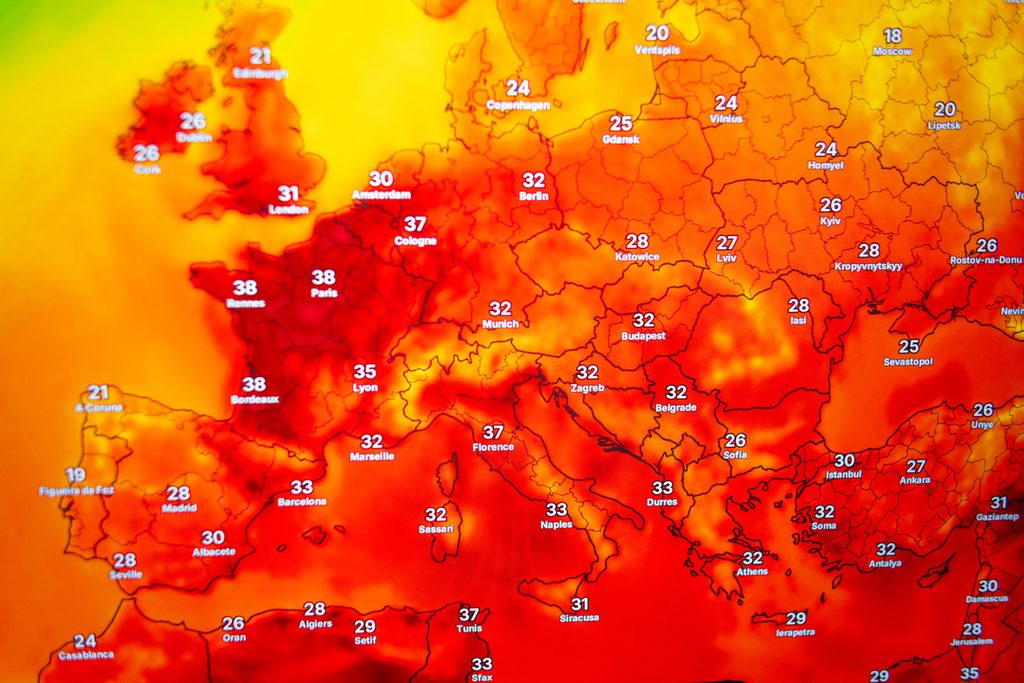
How Hot Does Spain Get in Summer?
Hot.
And depending on where you’re traveling, potentially very hot.
July and August are typically the hottest part of the year across much of mainland Spain. AEMET’s climate atlas shows the highest summer maximum temperatures occurring particularly in Andalucía and Extremadura.
Inland destinations tend to feel the heat most intensely.
Cities such as Madrid, Sevilla, Córdoba, Granada, and Jaén can experience periods of intense summer heat. Temperatures during heat waves can climb well above the monthly averages.
If you’re planning a summer trip, don’t just look at an average temperature and assume that’s what you’ll experience every afternoon.
You may get something much hotter.
MUST SEE SPAIN TIP: If you’re traveling through southern or central Spain in July or August, build flexibility into your itinerary. Sightsee earlier in the morning, take a long lunch or indoor break during the hottest part of the afternoon, and head back out later.
Conveniently, that’s not all that different from the rhythm you’ll see around you.
Summer Heat Can Change the Way You Travel
The biggest mistake isn’t necessarily visiting Spain in summer.
It’s planning a July day like you would plan an April day.
An itinerary that has you walking across Sevilla from noon until 5 p.m. may look perfectly reasonable when you’re planning it from your couch. It can feel very different once you’re actually there.
For hot days:
- Start outdoor sightseeing early.
- Carry water.
- Wear breathable clothing.
- Use sunscreen and a hat.
- Look for shade whenever possible.
- Schedule museums, lunch, or indoor attractions during the hottest hours.
- Don’t underestimate how much walking you’ll do.
- Give yourself permission to slow down.
You do not need to squeeze another monument into the afternoon just because it fits on your spreadsheet.
How do you explore Spain during extreme heat?
Flip before planning your day.
CHANGE YOUR SCHEDULE, NOT JUST YOUR OUTFIT.
Plan outdoor sightseeing for the morning and evening, and use the hottest part of the day for lunch, museums, shopping, or a break.
Check the forecast and official heat alerts each day, especially during summer.
GET MY SPAIN HEALTH & SAFETY CHECKLIST →
Don’t Underestimate the Sun
Even when the temperature doesn’t seem extreme, the Spanish sun can be intense.
This is especially important if you’re spending hours walking around cities, sitting on terraces, visiting archaeological sites, hiking, or spending the day at the beach.
Pack sunscreen rather than assuming you’ll remember to buy it after you arrive. A hat, sunglasses, and reusable water bottle are also worth having.
And remember that cloudy or breezy weather doesn’t necessarily mean you can forget about sun protection.
What About Heat Exhaustion?
Heat isn’t only uncomfortable. Too much heat and sun can become a health issue.
Symptoms such as dizziness, headache, weakness, nausea, excessive sweating, or feeling unusually tired can be signs that your body isn’t handling the heat well.
Get somewhere cooler, rest, and hydrate. If someone becomes seriously ill, confused, loses consciousness, or you believe you’re dealing with a medical emergency, call 112, Spain’s general emergency number.
This is one of those things you hopefully never have to think about during your vacation. But knowing what to do before you need the information makes a stressful situation much easier.
Learn more about extreme heat in Spain here.
Be Prepared Before You Go
Weather is one of the reasons I don’t think health and safety planning should begin after you arrive in Spain.
My Spain Health & Safety Checklist helps you prepare before your trip so you know what to do and where to turn if something goes wrong.
Inside, you’ll find:
- Important emergency numbers in Spain
- How healthcare and pharmacies work
- What to know about traveling with medications
- Travel insurance reminders
- Common health and safety concerns
- What to prepare before you leave
- What to do if you need medical care while you’re in Spain
Keep it handy during your trip so you’re not trying to track down important information when you’re already stressed.
Get the Spain Health & Safety Checklist →
What Is Spain Like in Winter?
Here’s where Spain’s sunny reputation can fool people.
Spain can absolutely be cold.
Madrid has an average January temperature of around 6°C/43°F, with average nighttime lows around 3°C/37°F.
Northern and mountainous destinations can be colder still, and snow is possible in parts of the country.
Meanwhile, southern and coastal areas generally have milder winters.
Then there are the Canary Islands, where winter feels completely different. Spain’s official tourism site notes that average winter temperatures there are around 20°C/68°F.
So if you’re traveling in December, don’t ask, “What should I pack for Spain?”
Ask, “What should I pack for Madrid, Sevilla and Tenerife in December?“
That’s a much more useful question.
Spring and Fall in Spain
For many travelers, spring and fall are the sweet spots.
You can often avoid the most intense summer temperatures while still getting pleasant sightseeing weather.
April and May can be lovely for city trips, although rain is always possible.
September and October can also be excellent, especially if you want warm weather without planning your entire day around peak summer heat.
But again, location matters.
October in Galicia isn’t the same as October in Málaga.
If weather is one of your biggest priorities, choose your destination based on the season rather than assuming every part of Spain will have the weather you’re looking for.
When Is the Best Time to Visit Spain for Weather?
For a classic sightseeing trip covering cities such as Madrid, Barcelona, Sevilla, Granada, or Valencia, I’d look particularly closely at spring and early fall.
May, June, September, and early October can offer a nice balance, depending on your destinations.
That doesn’t mean you shouldn’t visit in July or August.
You just need to know what you’re signing up for.
Summer can make sense if you’re planning a beach vacation, need to travel around school schedules, or simply love hot weather. Winter can be fantastic for city trips, Christmas travel, skiing, or escaping to the Canary Islands.
There really isn’t one universally “best” month.
There is a best month for the trip you want to take.
Learn more about Spain weather here.
Let Your Travel Style Pick the Destination
Weather is only one part of choosing where and when to go.
If you’re still deciding what kind of Spain trip actually fits you, take my free Spain Travel Style Quiz.
Answer a few quick questions about how you like to travel, and you’ll discover the destinations, experiences, food, culture, and little moments in Spain that fit your travel style.
Because your perfect Spain trip isn’t necessarily someone else’s.
Take the Free Spain Travel Style Quiz →
Weather & Heat in Spain: FAQs
What is the average temperature in Spain by month?
There isn’t one meaningful monthly average that represents all of Spain because temperatures vary significantly by region. As a general pattern, January and February are among the coldest months, temperatures rise through spring, July and August are the hottest months across much of the mainland, and temperatures begin cooling again in September and October.
For perspective, AEMET’s climate normals for Madrid show an average temperature of about 6°C/43°F in January and 26°C/78°F in July, while coastal, northern, southern, mountainous, and island destinations can be considerably different.
Always check monthly averages for the specific Spanish destinations you’re planning to visit.
What is the hottest month in Spain?
July is generally one of the hottest months in Spain, although July and August are both peak summer heat months and the exact hottest month varies by location. AEMET climate data illustrates the regional variation: Jaén averages about 27.6°C/82°F in July, while Almería’s average temperature peaks around 26.7°C/80°F in August.
Actual temperatures during a heat wave can be much higher than monthly averages.
What is the best month to travel to Spain?
May, June, September, and early October are excellent times to consider for many Spain itineraries, but the best month depends on where you’re going and what you want to do. Spring and early fall can offer comfortable temperatures for sightseeing without the peak summer heat.
For beaches and summer atmosphere, July and August may be exactly what you want. For cooler sightseeing and fewer peak-season crowds, winter can also be worth considering.
Which part of Spain is the hottest all year round?
Southern Spain and the Canary Islands are among Spain’s warmest areas, but “hottest all year” depends on whether you mean summer extremes or consistently mild winter temperatures. Inland Andalucía and Extremadura experience some of mainland Spain’s highest summer temperatures, while the Canary Islands are particularly notable for their mild year-round climate and winter temperatures averaging around 20°C/68°F.
If your goal is winter sunshine rather than extreme summer heat, the Canary Islands are the more relevant choice.
The Bottom Line
The most important thing to understand about weather & heat in Spain is that Spain doesn’t have one climate.
You could be packing a winter coat for Madrid, a rain jacket for Galicia, or beach clothes for the Canary Islands depending on where and when you’re traveling.
And summer deserves particular attention. July and August can be intensely hot in central and southern Spain, so your itinerary may need to change along with your wardrobe.
Check the forecast for each destination, pay attention to heat warnings, pack for the actual region you’re visiting, and don’t be afraid to slow down when Spain turns up the temperature.
The goal isn’t to see how much sightseeing you can survive.
It’s to enjoy being there.



Be the first to comment