


If you’re planning to visit several Spanish cities in one trip, there’s a good chance the train will be one of the easiest ways to get between them.
Spain has an extensive rail network, including high-speed trains connecting many of its most popular destinations. Madrid, Barcelona, Valencia, Sevilla, Málaga, Córdoba, Alicante and many other cities can be combined without ever renting a car.
And unlike flying, taking the train usually means traveling from one city center to another without trekking out to an airport.
But traveling by train in Spain can be confusing the first time you do it.
What’s the difference between AVE and Avlo? Is Renfe the only train company? Do you need to book ahead? Where does your suitcase go? And why does Madrid have more than one major train station?
Here’s what you need to know.
A quick note before we go: Some links in this post may be affiliate links, which means I may earn a small commission if you book or buy through them, at no extra cost to you. Think of it as helping fund my next café con leche while I keep bringing you the best Spain travel tips. I only share things I’d genuinely recommend for your trip.
Is Traveling by Train in Spain Easy?
For many itineraries, yes.
Spain has one of the world’s largest high-speed rail networks, and dozens of destinations are connected by high-speed services.
For a first trip built around cities such as Madrid, Barcelona, Sevilla, Córdoba, Valencia or Málaga, I would usually look at the train before considering a rental car.
You avoid driving in unfamiliar cities, finding parking, and returning a rental car. You can also sit back, read, work, stare out the window or start planning where you’re going to eat when you arrive.
The biggest limitation is that Spain’s rail network isn’t equally convenient everywhere.
If you’re exploring small villages, rural areas, some coastal destinations, or places well away from the major rail corridors, a car or bus may make more sense.
Understanding Spain’s Trains
You’ll see several different train names while planning your trip.
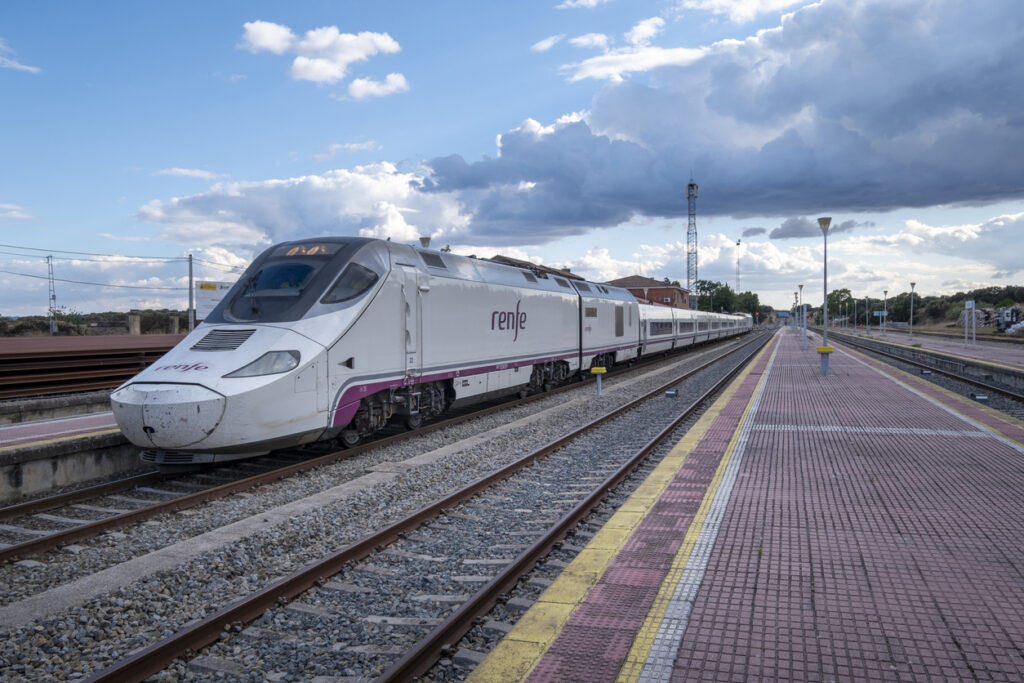
AVE is Renfe’s flagship high-speed service and connects many major Spanish cities.
Avlo is Renfe’s lower-cost high-speed option. The fare structure and luggage rules differ from standard Renfe services, so don’t assume that everything included with one train is included with another.
You’ll also encounter names such as Alvia, Euromed, Intercity and Media Distancia, depending on the route and type of service.
Then there are Cercanías, the commuter rail networks serving Madrid and several other metropolitan areas. These are useful for shorter local and suburban journeys rather than long-distance sightseeing routes.
The good news is that you don’t need to memorize all of this before you arrive.
When planning traveling by train in Spain, start with your origin, destination and travel date. Then compare the actual options available for that journey.
Renfe Isn’t the Only Train Company
This surprises a lot of first-time visitors.
Renfe is Spain’s national railway operator and remains a major player, but there is now competition on several high-speed routes.
Depending on your journey, you may also see trains operated by Iryo or Ouigo España.
That means searching only one operator’s website won’t necessarily show you every train you could take.
This is one reason I like using a comparison tool when I’m planning. You can look at departure times, journey lengths and prices without opening several different websites.
Compare Spain Train Tickets in One Place
For travelers who want to compare options, Omio can make the process much simpler.
Rather than searching individual train companies one at a time, you can compare available transportation options for your route and find the departure that works best for your itinerary.
This is especially helpful now that some major Spanish rail routes have multiple operators.
Compare trains and book your Spain tickets with Omio →
Affiliate link. I may earn a commission at no extra cost to you.
Should You Book Spanish Trains in Advance?
For long-distance and high-speed trains, I recommend it.
Don’t treat an AVE journey like a city Metro where you simply show up whenever you’re ready to leave.
Popular departures can sell out, and booking ahead gives you more choices of departure times and fares.
This becomes even more important if you’re traveling during a holiday, festival, summer vacation period or other busy time.
You don’t necessarily need to book every train months ahead. But once your itinerary and hotel dates are fixed, there’s little advantage to waiting until you’re standing in the station to start looking at your long-distance options.
Local commuter services are different. Those are generally much more spontaneous.
Plan Your Spain Trip Without the Spreadsheet Chaos
Once you start combining Madrid, Barcelona, Sevilla, Valencia, Málaga, or anywhere else into one trip, there are suddenly a lot of details to keep track of.
Train times. Hotel dates. Reservations. Activities. Confirmation numbers. Your daily itinerary. And, of course, all the restaurants you absolutely cannot forget about.
I created my Spain Travel Planner for Google Sheets to keep all of that in one place.
It’s a digital planner you can access from your phone, tablet, or computer while you’re planning your trip and while you’re actually traveling through Spain.
Use it to organize your itinerary, keep track of reservations and transportation, and map out the details of your trip without having information scattered across emails, screenshots, notes, and seventeen open browser tabs.
It’s especially useful for a multi-city train trip because you can see how all the pieces of your itinerary fit together before you start booking.
Plan the trip once. Know where everything is. Then spend your time in Spain actually enjoying it.
Get the Spain Travel Planner for Google Sheets →
What Are Spain’s Train Stations Like?
Large Spanish train stations function a little like miniature airports.
You’ll find departure boards, cafés, shops, ticket machines and waiting areas, although facilities vary by station.
For some high-speed and long-distance services, you’ll pass through a security check before reaching the boarding area. It’s considerably simpler than airport security, but it’s another reason not to arrive two minutes before departure.
I like giving myself enough time to find the correct departure area without turning the beginning of every train journey into a sprint.
Also, pay attention to the exact station name on your ticket.
Cities can have multiple railway stations.
In Madrid, for example, you’ll frequently encounter Madrid-Puerta de Atocha-Almudena Grandes and Madrid-Chamartín-Clara Campoamor. Which one you need depends on your train.
“Train station in Madrid” isn’t specific enough.
What Do You Do With Your Luggage?
One of my favorite things about traveling by train in Spain is not having to check a normal suitcase the way you would for a flight.
On standard Renfe services within Spain, passengers can generally bring up to three pieces of hand luggage as long as they stay within Renfe’s combined weight and size limits. Renfe currently lists a combined maximum of 25 kilograms and 290 centimeters for the three pieces, with additional dimensional restrictions.
You’ll usually store smaller bags above your seat and larger suitcases in designated luggage areas.
But don’t assume every train company and fare has identical rules.
Avlo has more restrictive luggage allowances. Its basic fare currently includes one smaller hand item and one cabin-size suitcase, with larger additional luggage available for an extra charge subject to its rules.
Check the luggage policy for your specific operator and ticket before leaving home, particularly if you’re traveling with large suitcases, bicycles, sports equipment or other unusual luggage.
And keep your valuables with you rather than inside a suitcase sitting in a luggage rack.
Keep an Eye on Your Belongings
Spanish trains are generally a comfortable way to travel, but train stations and transportation hubs are also places where travelers should pay attention to their belongings.
Keep your phone, wallet, passport and other valuables in a secure bag rather than tucked into an easy-to-reach pocket.
If you put a large suitcase in a luggage area, don’t leave your passport, cash and every credit card inside it.
This isn’t a reason to be nervous. It’s the same practical awareness I’d use in any busy European transportation hub.
If you’re concerned about theft, read my guide to Pickpockets and Scams in Spain before your trip.
High-Speed Train or Plane?
For many journeys within Spain, the train is my first choice.
The big advantage isn’t simply how fast the train moves. It’s the entire journey.
Train stations are often centrally located, you don’t have the same airport process, and when you arrive, you’re frequently already in or near the city rather than facing another airport transfer.
Madrid to Barcelona is a classic example of a route where high-speed rail makes sense.
Madrid also works particularly well as a base for rail travel because so many routes connect through the capital. Spain’s official tourism authority describes Madrid as a key starting point for exploring the country’s high-speed network.
That doesn’t mean the train always wins.
For journeys to Spain’s islands, obviously, you’re looking at a flight or ferry. And for some very long journeys or routes without convenient direct rail service, flying may still make more sense.
Compare the entire door-to-door trip, not just the scheduled travel time.
Some of the Best Trips to Take by Train in Spain
Spain’s rail system makes it particularly easy to combine major cities.
Madrid and Barcelona are an obvious pair. Madrid also connects beautifully with Córdoba and Sevilla for a trip that combines central Spain and Andalucía.
Madrid to Valencia is another easy combination if you want to add the Mediterranean coast.
You can also build a route around Barcelona and Valencia or use high-speed trains to travel south toward Málaga.
And don’t overlook shorter trips.
Madrid to Toledo makes an excellent day trip. Córdoba can work beautifully between Madrid and Sevilla. Depending on your itinerary, the train can let you experience another destination without changing hotels every night.
The trick is not trying to cover the entire country just because the trains are fast.
Spain is still a big country. Give yourself time to actually experience the places you visit.
What Is the Most Scenic Train Ride in Spain?
If your goal isn’t simply getting from A to B, Spain has some spectacular tourist train journeys.
Northern Spain is particularly impressive.
Spain’s official tourism site highlights the Transcantábrico Gran Lujo, an eight-day journey between San Sebastián and Santiago de Compostela, as well as the Costa Verde Express. These routes travel through northern Spain’s green landscapes, mountains and areas along the Cantabrian coast.
There are also shorter tourist rail experiences around Spain, including the Tren dels Llacs, the Sóller railway in Mallorca and several historic or themed trains.
These are very different experiences from taking an AVE from Madrid to Sevilla.
One is transportation.
The other is part of the vacation itself.
What Happens If Your Train Is Delayed?
Keep your ticket and pay attention to information from your train operator.
Passenger rights, refund eligibility and rebooking options can depend on the operator, type of ticket and circumstances.
If you’re building separate train journeys into the same day, give yourself some breathing room rather than creating an itinerary where one small delay ruins everything that follows.
I especially wouldn’t schedule an important international flight immediately after a complicated chain of separately booked rail connections.
A little buffer time is worth it.
Do You Need a Rail Pass for Spain?
Not necessarily.
For many travelers with a relatively simple itinerary, buying individual tickets can be easier.
A rail pass becomes more interesting if you’re planning substantial train travel and want flexibility, but don’t assume a pass will automatically save money.
Compare what your actual journeys would cost individually against the price and restrictions of the pass you’re considering.
Renfe also offers a Spain Rail Pass aimed at international travelers, so it’s worth comparing if you’re planning multiple rail journeys.
Train Travel With Mobility Needs
If you or someone you’re traveling with needs mobility assistance, don’t assume you’ll have to figure everything out at the station.
Renfe provides an assistance service for travelers with disabilities or reduced mobility, including assistance navigating stations and boarding trains. Some services need to be requested in advance.
Check the requirements for your particular journey before traveling so the appropriate assistance can be arranged.
My Biggest Tip for Traveling by Train in Spain
Don’t overcomplicate it.
You don’t need to become an expert on the Spanish railway system before your vacation.
Know where you’re going. Compare your train options. Book long-distance journeys ahead when it makes sense. Check which station you’re leaving from. Read the luggage rules for your particular ticket. Arrive with enough time to find your train.
Then get on and enjoy the ride.
For a lot of Spain itineraries, train travel isn’t simply transportation. It’s one of the things that makes exploring several parts of the country surprisingly easy.
Not Sure Where to Go in Spain?
Before you start booking train tickets, make sure you’re choosing destinations that actually fit the way you like to travel.
Take my free Spain Travel Style Quiz.
Answer a few quick questions about how you like to travel, and you’ll discover the destinations, experiences, food, culture, and little moments in Spain that fit your travel style.
Because the best train itinerary isn’t the one that covers the most cities.
It’s the one that takes you somewhere you’ll actually love.
Take the Free Spain Travel Style Quiz →
Traveling by Train in Spain: FAQs
Is it easy to travel around Spain by train?
Yes, traveling around Spain by train is easy for many popular tourist routes, particularly between major cities connected by high-speed rail.
Madrid, Barcelona, Sevilla, Córdoba, Valencia, Málaga and many other destinations have convenient rail connections. Smaller villages and rural destinations may require a bus, rental car or combination of transportation.
Why is there a travel warning for Spain?
Travel advisories for Spain can include concerns such as terrorism, demonstrations, crime or other current security issues, depending on the issuing government and the situation at the time.
A travel advisory does not necessarily mean tourists should avoid Spain. Because advisory levels and guidance can change, travelers should check their own government’s current official advice shortly before departure rather than relying on an old article or social media post.
For U.S. travelers, check the current U.S. Department of State Spain Travel Advisory before your trip.
What is the most scenic train journey in Spain?
The Transcantábrico through northern Spain is one of Spain’s most celebrated scenic rail journeys. The luxury route travels between San Sebastián and Santiago de Compostela through the landscapes of Green Spain, including areas of the Basque Country, Cantabria, Asturias and Galicia.
Spain also has several other scenic and tourist trains if you want the rail journey itself to be part of your vacation.
Are jeans okay to wear in Spain?
Yes, jeans are completely normal to wear in Spain. You don’t need a special wardrobe for traveling by train or sightseeing in Spanish cities.
Comfortable, neat casual clothing works well for most train journeys. Your bigger consideration should be the weather. Heavy jeans may not be particularly comfortable during very hot summer weather, especially in southern and central Spain.
The Bottom Line
Traveling by train in Spain is one of the easiest ways to build a multi-city Spanish vacation.
The high-speed network makes it possible to move between many major destinations quickly, and traveling from city center to city center can be much more convenient than flying.
Book your important long-distance trains ahead. Compare operators instead of assuming Renfe is your only choice. Double-check your departure station. Know the luggage rules attached to your fare. Keep your valuables secure.
Most importantly, don’t try to cram six cities into your itinerary simply because the train technically makes it possible.
The best part of traveling through Spain isn’t how quickly you can get to the next place.
It’s having enough time to enjoy the one you’re already in.
Further Reading
The Ultimate Guide to Solo Travel in Europe: Carry-On OnlyThe Ultimate Guide to Renting a Car in Spain: Best Companies and Deals
Your Complete Guide to the Train From Madrid to Barcelona
How to Book Trains in Spain: Comparing Trainline vs. Omio for the Best Experience



Be the first to comment