


The first time you stand in front of a Metro map in Spain, it can look like a colorful plate of spaghetti.
Ten minutes later, you’ll probably wonder why you were worried.
Spain’s larger cities have excellent public transportation, and the Metro is often one of the fastest and easiest ways to get around. Once you understand how to find your line, choose the right direction and buy a ticket, it’s surprisingly straightforward.
This Spain Metro guide covers what tourists actually need to know, from tickets and transfers to airport routes, escalator etiquette and that mildly panicked moment when you realize you’re standing on the wrong platform.
Because yes, I’ve done that too.
A quick note before we go: Some links in this post may be affiliate links, which means I may earn a small commission if you book or buy through them, at no extra cost to you. Think of it as helping fund my next café con leche while I keep bringing you the best Spain travel tips. I only share things I’d genuinely recommend for your trip.
Does Spain Have a Metro Everywhere?
No, and that’s the first thing to understand.
Spain doesn’t have one national Metro system. Public transportation is organized locally, so the system, ticket types, prices and rules depend on the city you’re visiting.
You’ll find Metro or metro-style networks in several major urban areas, including Madrid, Barcelona, Valencia, Bilbao, Málaga, Sevilla and Granada.
In smaller cities and towns, you’re more likely to rely on buses, trams, local trains, taxis and your own two feet.
Spain’s official tourism authority notes that larger cities generally have extensive Metro, train and bus networks, while many historic centers are compact enough to explore on foot.
That combination is actually one of my favorite things about traveling in Spain.
Take the Metro across town. Get off. Then walk.
How Does the Metro Work in Spain?
If you’ve used an underground railway in another major city, the basic system will feel familiar.
Each Metro line has a number, name or color. Find the station where you are, find the station where you want to go, and identify the line connecting them.
The part that sometimes trips people up is choosing the direction.
Instead of simply looking for your destination on a sign, you may need to know the final station at the end of the line in the direction you’re traveling.
So before walking onto a platform, look at the Metro map and figure out which direction you need.
If you have to change lines, follow the signs for correspondencia, which means a connection or transfer.
MUST SEE SPAIN TIP: Before heading underground, pull up your route on your phone and take a screenshot. You won’t have to stand in the middle of a busy station trying to figure out where you’re going.
Buying Metro Tickets in Spain
There isn’t one Metro ticket that works across Spain.
Madrid has its own system. Barcelona has another. Valencia has another.
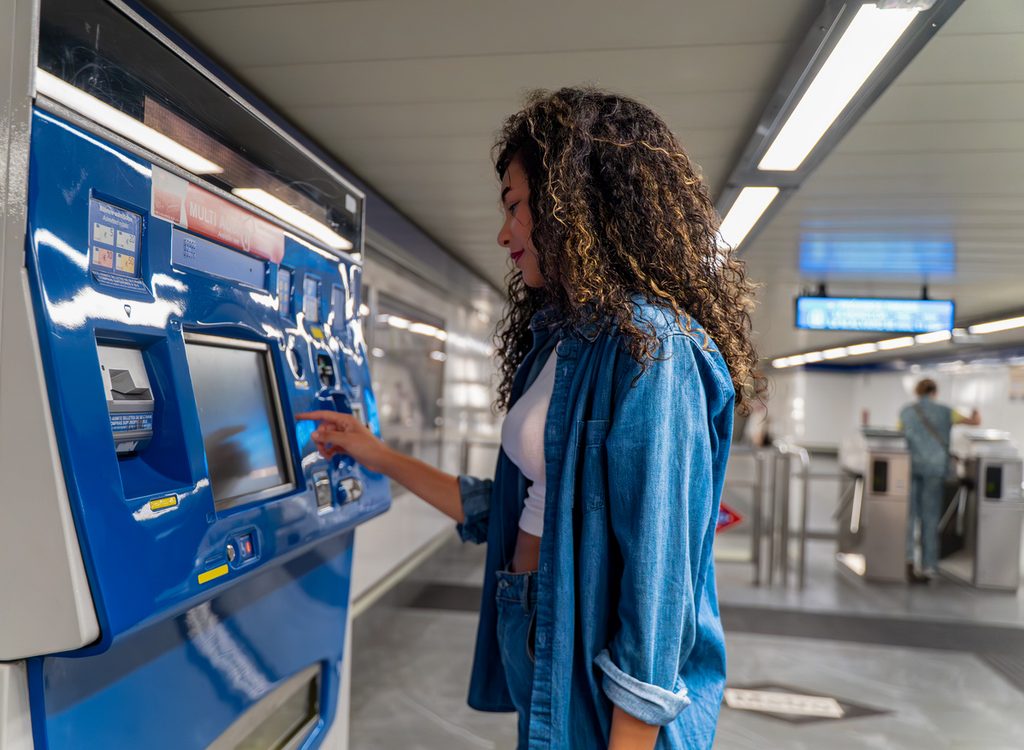
You’ll usually find ticket machines at Metro stations, and many offer an English-language option. Depending on the city and ticket, you may be able to use a physical transport card, rechargeable card, mobile system or bank card.
The important thing is not to automatically buy a single ticket every time you enter the Metro.
If you’re staying for several days and expect to use public transportation regularly, a multi-journey or unlimited-use option may cost less.
In Barcelona, for example, TMB currently offers several options ranging from single tickets to multi-journey and unlimited passes. Its 2026 one-zone T-casual includes 10 journeys, while the T-usual offers unlimited journeys for 30 consecutive days.
The right ticket depends on how long you’re staying and how often you’ll actually use public transportation.
Don’t Assume the Airport Works the Same Way
This is one of those tiny details that can cause unnecessary confusion.
Airport journeys can have different fares or ticket requirements.
Barcelona is a good example. A regular TMB single ticket isn’t valid at the Aeroport T1 and Aeroport T2 Metro stations on L9 Sud. Barcelona sells a separate airport Metro ticket, which costs €5.90 in 2026. Some other travel products do include airport travel.
Madrid also has specific airport fare rules.
So don’t assume that because you bought a normal city ticket, you’re automatically covered for the airport.
Check the current rules for your city before your travel day.
Madrid Metro: One of the Easiest Ways to See the City
Madrid is where I really came to appreciate having a good Metro system.
The city is wonderfully walkable when you’re exploring individual neighborhoods, but Madrid is big. Sometimes the place you want to go is simply too far away to justify walking there and back.
That’s where the Metro becomes incredibly useful.
Madrid’s Metro reaches across the city and into surrounding communities. It currently operates from 6:00 a.m. until 1:30 a.m. every day, according to Spain’s official tourism site.
For sightseeing, you’ll quickly become familiar with stations around areas such as Sol, Gran Vía, Retiro, Plaza de España and Atocha.
But don’t spend your entire trip underground just because the Metro is convenient.
One of the best ways to experience Madrid is to take the Metro to the neighborhood you want to explore and then walk from there.
Barcelona Metro: Fast, Useful and Worth Learning
Barcelona is another city where the Metro can save you a lot of time.
Major attractions are spread across the city, and while walking is part of the fun, you probably don’t want every sightseeing day to turn into an accidental endurance event.
Barcelona’s integrated transportation system can look a little more complicated at first because there are different ticket types and fare zones.
For most tourists spending their time within central Barcelona, the biggest decision is usually which ticket makes sense for the number of journeys they expect to take.
As of 2026, a one-zone Barcelona single ticket costs €2.90 and a one-zone T-casual with 10 journeys costs €13.
That illustrates why it’s worth doing the math before repeatedly purchasing single tickets.
Is the Hola Barcelona Travel Card Worth It?
If you’re going to use public transportation frequently while you’re in Barcelona, another option worth looking at is the Hola Barcelona Travel Card.
The card gives you unlimited journeys on Barcelona’s public transportation network for a set period of time, with options for 48, 72, 96 or 120 hours. It covers the Metro, TMB buses, trams, the Montjuïc funicular, certain FGC and Rodalies services within Zone 1, and, importantly for many visitors, Metro travel between Barcelona Airport and the city.
That airport access is one of the reasons I think it’s worth comparing the Hola Barcelona card with the other ticket options before your trip. A regular Barcelona Metro single ticket doesn’t cover the airport Metro stations, so the math can look different once your airport journeys are included.
The Hola Barcelona card isn’t automatically the cheapest choice for everyone.
If you love walking and expect to take the Metro only a couple of times each day, another ticket may make more sense. But if you’re planning several days of sightseeing and expect to hop between places like the Sagrada Família, Gothic Quarter, Park Güell, Montjuïc and other parts of the city, unlimited transportation can be incredibly convenient.
There’s also something nice about not doing mental math every time you want to get on the Metro.
You’ve already paid for your transportation. Just tap in and go.
MUST SEE SPAIN TIP: Before buying the Hola Barcelona Travel Card, roughly map out your itinerary and estimate how often you’ll use public transportation. Don’t buy a tourist pass simply because you’re a tourist. Buy it because it actually makes sense for the way you plan to explore Barcelona.
You can check the current prices, included transportation and purchase options directly through the official Hola Barcelona website before your trip.
Check Hola Barcelona Travel Card options →
What About Valencia, Sevilla, Málaga, Bilbao and Granada?
Madrid and Barcelona get most of the attention, but they’re not your only opportunities to use urban rail in Spain.
Valencia has a combined Metro and tram network that can be especially useful for reaching places beyond the historic center.
Bilbao’s Metro is useful for exploring the city and surrounding areas.
Sevilla has a Metro system, although tourists often find themselves walking through much of the historic center.
Málaga’s Metro is useful for certain parts of the city, while the historic center itself is extremely walkable.
Granada has a light Metro system that operates more like a modern tram in some areas.
This is why there really isn’t one universal set of instructions for using “the Metro in Spain.”
The basic idea is the same.
The details are local.
Walking + Metro Is Usually the Sweet Spot
You don’t need to take the Metro three stops simply because it’s there.
In many Spanish cities, some of your favorite moments will happen while you’re walking between places.
You’ll pass a bakery you didn’t know existed. Find a tiny plaza. Notice a tapas bar packed with locals. Stop for coffee. Walk into a market.
That’s part of Spain.
I like using the Metro to cover the boring distance and walking the interesting parts.
If Google Maps says the journey is 28 minutes on foot or 20 minutes once you walk to the Metro, wait for a train and walk from the next station, I’d probably walk.
If it’s 50 minutes on foot and 14 minutes by Metro?
I’m going underground.
Plan Your Transportation Before You Get There
When you’re planning several days in Madrid, Barcelona or another Spanish city, it helps to know which attractions are near each other.
Otherwise, it’s very easy to spend your day zigzagging across the city.
That’s one reason I created my Spain Travel Planner for Google Sheets.
You can organize your daily itinerary, transportation, hotel information, reservations, tickets and trip details in one place that you can access from your phone, tablet or computer.
Group the things you want to see by neighborhood, map out your travel days and keep the practical details together instead of digging through emails, screenshots and seventeen open tabs.
Your vacation should involve more tapas and fewer frantic searches for confirmation numbers.
Get the Spain Travel Planner for Google Sheets →
Metro Etiquette in Spain
You don’t need to learn a complicated list of cultural rules before stepping onto the Metro.
Mostly, use common sense.
Let passengers get off before you try to board. Don’t stop directly in front of the train doors while figuring out where you’re going. Move farther into the carriage when it’s crowded.
If you’re carrying a backpack in a packed train, be aware of how much room it’s taking up.
And don’t block an escalator while having a family meeting about which direction everyone thinks the hotel is.
Move out of the flow of people first. Then regroup.
Watch Your Belongings
Busy Metro systems are one of the places where you should pay closer attention to your belongings.
Crowded trains, escalators, platforms and the moments when everyone is squeezing through doors create opportunities for pickpocketing.
Keep your bag zipped and close to your body. Don’t put your phone into an open pocket after checking directions. Pay attention when you’re getting on and off the train.
You don’t need to clutch your purse in terror for the entire journey.
Just don’t make your belongings easy to take.
For more specific advice, read my Pickpockets and Scams in Spain guide before your trip.
What If You Get on the Wrong Metro?
Congratulations. You’re now officially a traveler.
It happens.
Get off at the next convenient station, look at the map and correct your route.
If you’ve accidentally traveled in the wrong direction, you can usually cross to the opposite platform within the station and head back.
Missing a stop isn’t a catastrophe either.
The Metro is not an airplane. You haven’t accidentally ended up in Portugal.
Get off. Turn around. Carry on.
Can You Take Luggage on the Metro?
Yes, tourists regularly use public transportation with luggage.
Whether you want to is another question.
A suitcase on the Metro during a quieter part of the day can be perfectly manageable.
Dragging two giant suitcases, a carry-on and three children onto a packed train during rush hour is a very different experience.
If you’re arriving with a lot of luggage, compare the convenience and cost of the Metro with an airport bus, taxi or other transfer option.
Sometimes paying a little more is worth avoiding an exhausting start to your trip.
Should You Use Google Maps for the Metro?
I do.
Google Maps is useful for figuring out which station to use, which line to take, where to transfer and how far you’ll need to walk at either end.
Still, pay attention to the actual station signs once you’re underground.
Transit routes can change because of maintenance, temporary closures or service disruptions.
I also like knowing the name of the station where I’m getting off rather than blindly following my phone for the entire journey.
It makes navigating much less stressful.
Build a Spain Trip That Fits You
Maybe your perfect Spain trip is Madrid and Barcelona with Metro stations around every corner.
Maybe it’s Sevilla, where you spend most of your time wandering through the historic center.
Maybe you’re happiest in a tiny Spanish town where the closest thing to a Metro is someone telling you, “It’s about a ten-minute walk.”
That’s exactly why I created my free Spain Travel Style Quiz.
Answer a few quick questions about how you like to travel, and you’ll discover the destinations, experiences, food, culture and little moments in Spain that fit your travel style.
Because the best Spain itinerary isn’t the one that checks off the most famous cities.
It’s the one that feels like your kind of trip.
Take the Free Spain Travel Style Quiz →
Spain Metro Guide: FAQs
How do I pay for Metro in Spain?
You can usually pay for Metro travel in Spain by purchasing a ticket or travel card through the local city’s transportation system.
Payment methods and ticket options vary by city. Ticket machines are common at stations, and some systems also support rechargeable transport cards, mobile tickets or bank-card payment in certain locations. There is no single Metro ticket used throughout Spain, so check the official transportation authority for the city you’re visiting.
What is the cheapest way to get around in Spain?
Walking and public transportation are usually among the cheapest ways to get around Spanish cities.
For travelers making several Metro or bus journeys, multi-journey tickets or travel passes can be cheaper than buying individual tickets. The best option depends on the city, how long you’re staying and how often you expect to use public transportation.
For travel between cities, compare trains, buses and other options rather than assuming one method will always be cheapest.
How much does a single ticket for the Metro cost in Spain?
There is no single nationwide Metro fare in Spain because each city’s transportation system sets its own ticket prices.
For example, a one-zone single ticket on Barcelona’s TMB network costs €2.90 in 2026, while airport Metro travel has a different fare.
Always check current fares for the specific city you’re visiting because prices and ticket structures can change.
Is the Metro easy to use in Madrid?
Yes, Madrid’s Metro is generally easy for tourists to use and connects much of the city and surrounding area.
Once you know your line, direction and destination station, navigating the system is straightforward. Madrid Metro currently operates daily from 6:00 a.m. until 1:30 a.m., making it useful for both sightseeing and getting around in the evening.
The Bottom Line
Using the Metro in Spain sounds much more complicated before you do it than after.
There isn’t one national system, so ticket types, prices and rules change from city to city. But the basic process is simple: find your station, choose your line, make sure you’re traveling in the right direction and keep track of where you’re getting off.
For cities like Madrid and Barcelona, the Metro can save an enormous amount of time.
Use it when the distance is long.
Walk when the journey itself looks interesting.
And if you accidentally take Line 2 three stops in the wrong direction?
You’ll figure it out.
Sometimes getting a little lost is just part of Spain.
Further Reading
Travel Insurance for Spain: What Tourists Need to Know
Exploring Spain by Car: How to Navigate the Major Cities with Ease
The Ultimate Guide to Renting a Car in Spain: Best Companies and Deals



Be the first to comment