


Getting sick is probably not part of your Spain itinerary. But headaches, stomach bugs, allergies, blisters, forgotten medications, and other little health problems don’t exactly care that you’re on vacation.
The good news is that pharmacies in Spain are incredibly useful.
In fact, your first stop for a minor health problem in Spain often doesn’t need to be a doctor’s office. Spanish pharmacists are trained healthcare professionals who can help with many common problems, recommend appropriate over-the-counter treatments, and tell you when your symptoms need medical attention instead.
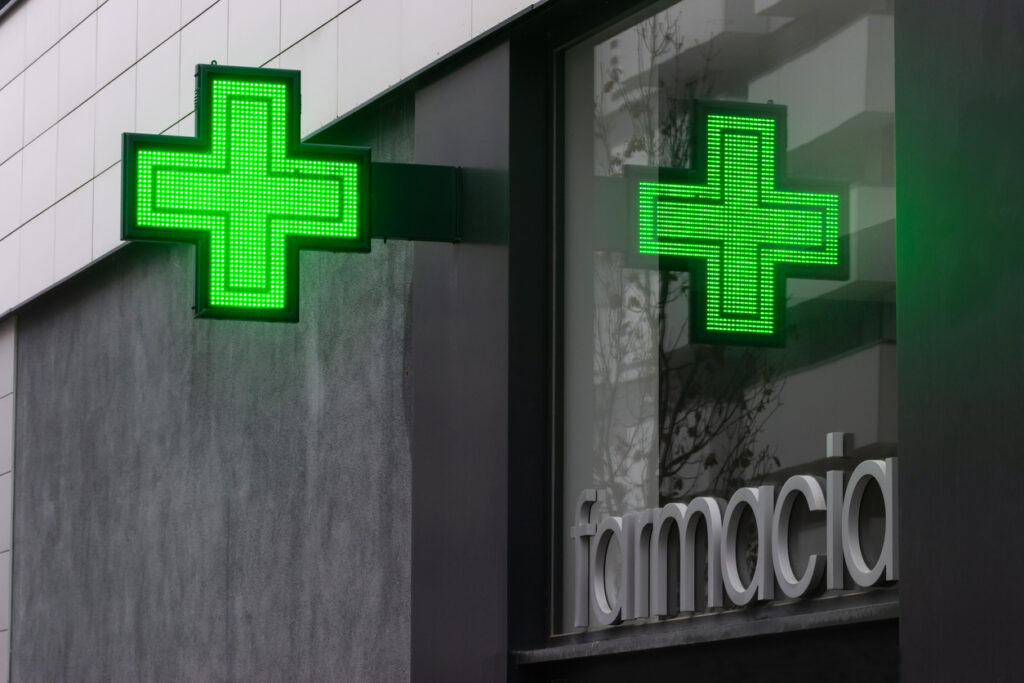
There are also pharmacies everywhere. Once you know to look for the distinctive green cross, you’ll start noticing them all over Spanish cities and towns.
Here’s what travelers should know about pharmacies, medications, doctors, and getting medical help in Spain.
A quick note before we go: Some links in this post may be affiliate links, which means I may earn a small commission if you book or buy through them, at no extra cost to you. Think of it as helping fund my next café con leche while I keep bringing you the best Spain travel tips. I only share things I’d genuinely recommend for your trip.
How Do Pharmacies Work in Spain?
A pharmacy in Spain is called a farmacia, and you’ll recognize one by the green cross displayed outside.
Don’t confuse a Spanish pharmacy with a typical drugstore you might find elsewhere.
Spanish pharmacies specialize in medications and health-related products. If you need pain relievers, cold medicine, allergy medication, first-aid supplies, or advice about a minor medical issue, the farmacia is the place to go.
Medication in Spain is sold through pharmacies rather than ordinary supermarkets and convenience stores.
Need a pharmacy after hours?
Flip to find out what to look for.
Look for a farmacia de guardia.
These are pharmacies providing service outside normal opening hours. If a pharmacy is closed, check the door for information about the nearest on-duty pharmacy.
Useful phrase:
¿Dónde está la farmacia de guardia?
Where is the on-duty pharmacy?
KNOW BEFORE YOU GO: Learn to recognize the green pharmacy cross. When you’re feeling terrible in an unfamiliar city, knowing exactly what you’re looking for makes life much easier.
Pharmacists Can Help With Minor Health Problems
One of the best things to know before traveling to Spain is just how helpful a pharmacist can be.
If you have a relatively minor problem, you can walk into a pharmacy and explain what’s happening. The pharmacist may be able to recommend an appropriate nonprescription treatment or tell you that you should see a doctor.
This can be particularly useful for everyday travel problems such as minor aches, cold symptoms, allergies, stomach complaints, insect bites, blisters, or other non-emergency concerns.
You don’t need to know the name of the Spanish equivalent of whatever medication you’d normally buy at home.
Tell the pharmacist your symptoms.
If your Spanish isn’t great, use a translation app or show them the generic or active ingredient in a medication you normally use.
Useful Spanish Phrases at the Pharmacy
A little Spanish can make the interaction much easier.
¿Hay una farmacia cerca?
Is there a pharmacy nearby?
Necesito una farmacia.
I need a pharmacy.
Me duele la cabeza.
My head hurts.
Me duele el estómago.
My stomach hurts.
Tengo fiebre.
I have a fever.
Tengo alergia a…
I’m allergic to…
Necesito algo para…
I need something for…
¿Necesito receta?
Do I need a prescription?
¿Cómo se toma?
How do I take it?
¿Cuántas veces al día?
How many times a day?
¿Hay un médico cerca?
Is there a doctor nearby?
If explaining your symptoms gets complicated, your phone’s translation app is your friend.
Can You Buy Medication Without a Prescription in Spain?
Some medicines are available without a prescription, while others require a prescription from a doctor.
The important thing for travelers to understand is that the rules may not be the same as they are in your home country.
A medicine that’s sold over the counter at home may be handled differently in Spain. Likewise, the brand name you recognize may not be used in Spain even when the same active ingredient is available.
That’s why asking the pharmacist is often easier than walking in looking for a specific brand.
Instead of asking for your usual brand, tell the pharmacist what you need or provide the active ingredient.
For example, knowing the generic name of a medication can be much more useful internationally than knowing only its brand name.
Bring Enough of Your Regular Medication
If you take prescription medication regularly, don’t assume you’ll simply be able to replace it once you arrive in Spain.
The Spanish Agency for Medicines and Health Products recommends traveling with enough medication for the duration of your trip and keeping a record of the medicines you use, including the active ingredient, dosage, frequency, and reason you take it.
It’s also a good idea to travel with your medication in its original packaging and carry documentation for important prescriptions.
This becomes especially important with controlled medications or medicines that may be regulated differently in Spain.
MUST SEE SPAIN TIP: Before leaving home, make a simple medication list on your phone with the brand name, active ingredient, dosage, and why you take it. If you ever need a doctor or pharmacist abroad, you’ll be very glad you have it.
What If You Lose or Run Out of Prescription Medication?
This is where things can get more complicated.
A foreign prescription does not automatically mean you’ll be able to walk into any pharmacy and receive the same medication. Prescription rules, availability, brand names, and authorized medications can differ between countries.
If you lose your medication or run out, start by speaking with a pharmacist. Bring the medication packaging, a copy of your prescription, or your medication information if you have it.
The pharmacist can tell you whether the medication is available in Spain and whether you’ll need to see a doctor for a Spanish prescription.
Don’t wait until you’ve taken your final dose to start figuring this out.
What Is a Farmacia de Guardia?
This is one of the most useful things to know about pharmacies in Spain.
Regular pharmacies have set opening hours, but Spain also has systems for providing pharmacy services outside normal business hours.
You’ll often hear these referred to as farmacias de guardia, or on-duty pharmacies.
If the nearest pharmacy is closed, look at the information posted on the door. Pharmacies commonly display information about nearby pharmacies providing out-of-hours service.
You can also search:
farmacia de guardia + your location
This is particularly useful at night, on Sundays, and during public holidays.
SAVE THIS PHRASE: ¿Dónde está la farmacia de guardia? means “Where is the on-duty pharmacy?”
What If You Need a Doctor in Spain?
Sometimes a pharmacy isn’t enough.
If you’re seriously ill, have a significant injury, experience concerning symptoms, or the pharmacist recommends medical evaluation, seek professional medical care.
Spain has both public and private healthcare facilities.
According to Spain’s official tourism guidance, emergency treatment is guaranteed and is provided through hospitals and certain health centers. Private healthcare facilities charge for treatment.
What you’ll personally have to pay depends on factors such as your nationality, healthcare coverage, travel insurance, and the type of treatment you receive.
Travelers covered by systems such as the European Health Insurance Card may have different rights than visitors from countries without reciprocal healthcare arrangements.
This is one reason I strongly recommend figuring out your health coverage before you travel rather than after you get sick.
What Number Do You Call in an Emergency in Spain?
The emergency number in Spain is:
112
You can call 112 anywhere in Spain for urgent assistance involving medical emergencies, police, or fire services.
The call is free, and Spain’s official tourism authority says multilingual translation assistance is available.
Don’t use 112 for a minor problem that can be handled by a pharmacy or ordinary medical appointment. But if you’re facing a genuine emergency, don’t hesitate to call.
Be Ready Before Something Goes Wrong
Nobody wants to spend vacation time thinking about doctors, pharmacies, lost medications, or emergency rooms.
But figuring out the basics before you leave can make an already stressful situation much easier.
My Spain Health & Safety Checklist puts the important information in one place so you can prepare before your trip and keep it handy while you’re traveling.
Inside, you’ll find:
- Important emergency numbers in Spain
- How healthcare and pharmacies work
- What to know about traveling with medications
- Travel insurance reminders
- Common health and safety concerns
- What to prepare before you leave
- What to do if you need medical care while you’re in Spain
Hopefully, you’ll never need most of it.
But if you do, you’ll know where to start.
Get the Spain Health & Safety Checklist →
Should You Have Travel Medical Insurance for Spain?
It’s worth thinking about before your trip.
Spain’s official tourism authority recommends international medical insurance particularly for travelers who aren’t covered through an eligible European healthcare system or a country with an applicable bilateral healthcare agreement.
Your regular health insurance may provide limited international coverage or none at all, depending on your plan.
Before traveling, find out:
- Whether your existing insurance covers medical treatment in Spain
- Whether you would need to pay upfront
- How reimbursement works
- Whether emergency evacuation or repatriation is covered
- Whether your policy has exclusions
Don’t assume you’re covered simply because you have health insurance at home.
If you want to dig into this topic further, I have a complete guide to travel insurance for Spain that explains what to consider before choosing coverage.
Do you need travel medical insurance for Spain?
Flip to see what to consider before you go.
It depends on the coverage you already have.
Before your trip, check whether your current health insurance covers medical care in Spain, what you might have to pay out of pocket, and whether emergency evacuation or other travel-related medical expenses are covered.
Affiliate link. I may earn a commission at no extra cost to you.
A Few Health Items Worth Packing
You don’t need to bring an entire medicine cabinet to Spain. Pharmacies are easy to find.
But I like having a few basics with me so I don’t have to hunt for a pharmacy the second something minor happens.
Consider packing:
- Your regular prescription medications
- Copies or records of important prescriptions
- A basic pain reliever you know you tolerate
- Any allergy medication you regularly use
- A few adhesive bandages
- Blister treatment if you’ll be doing lots of walking
- Any specific medication or product you know you rely on
Spain involves a lot of walking for many travelers. Comfortable shoes and blister supplies are not exciting packing-list material, but your feet may eventually consider them the most important things in your suitcase.
Don’t Assume Familiar Brand Names Will Be Familiar in Spain
Medication brand names can change from country to country.
This is one of those tiny details that’s easy to overlook until you’re standing in a pharmacy trying to explain what you normally take.
Know the active ingredient in your medication.
Better yet, save it on your phone before you leave.
The Spanish medicines agency has specifically warned that identical or similar brand names can even refer to different medicines in different countries. Your pharmacist needs to know what medication you actually take, not simply what the box is called at home.
Can You Buy Medicine Online in Spain?
Be careful with online medication purchases.
Spain regulates online medicine sales. The Spanish Agency for Medicines and Health Products says legal online sales of nonprescription medicines must be made directly through authorized brick-and-mortar pharmacies that meet the country’s requirements.
For most travelers dealing with a minor illness during a vacation, walking into a legitimate local farmacia is usually much simpler anyway.
Don’t Forget the Rest of Your Spain Trip
Once you’ve handled the practical stuff, you can get back to planning the fun part.
If you’re still deciding where to go, take my free Spain Travel Style Quiz.
Answer a few quick questions about how you like to travel, and you’ll discover the destinations, experiences, food, culture, and little moments in Spain that fit your travel style.
Because your perfect Spain trip isn’t necessarily someone else’s.
Frequently Asked Questions About Health and Pharmacies in Spain
Are pharmacies easy to find in Spain?
Yes. Pharmacies are common throughout Spain and are easy to recognize by the green cross displayed outside.
Opening hours vary, but on-duty pharmacies provide access to pharmacy services outside normal hours. If a pharmacy is closed, check its door for information about nearby out-of-hours options.
Can tourists use pharmacies in Spain?
Yes. Travelers can visit pharmacies in Spain to purchase available medications and ask pharmacists for advice about minor health concerns.
If the medicine you need requires a prescription, the pharmacist can tell you what you’ll need to obtain it in Spain.
Can I get antibiotics over the counter in Spain?
Antibiotics that require a prescription should not be treated as over-the-counter medications in Spain.
If you think you need an antibiotic, speak with a pharmacist or doctor rather than assuming you can purchase one without medical evaluation.
What should I do if I get sick in Spain?
For a minor health problem, a pharmacy can be a useful first stop; for serious or concerning symptoms, seek medical care.
In a genuine emergency, call 112. It’s Spain’s nationwide emergency number and is free to call.
What is a farmacia de guardia in Spain?
A farmacia de guardia is a pharmacy providing service outside ordinary pharmacy hours.
These services help ensure access to medicines at night, on Sundays, or during holidays. Closed pharmacies may display information directing you to the nearest available option.
Do I need travel health insurance for Spain?
Whether you need additional coverage depends on what healthcare protection you already have, but travelers should confirm their medical coverage before visiting Spain.
Spain recommends international medical insurance particularly for travelers who aren’t covered through eligible European healthcare arrangements or applicable bilateral agreements.
The Bottom Line
Hopefully, the closest you get to needing healthcare in Spain is buying blister patches after realizing you’ve somehow walked 25,000 steps around Madrid.
But things happen.
Remember the green pharmacy cross. Know the active ingredients in your regular medications. Bring enough prescription medicine for your trip. Know that farmacias de guardia exist when ordinary pharmacies are closed.
And save 112 in the part of your brain reserved for information you hope you never need.
A little preparation now means that if something does go wrong, you can spend less time trying to figure out how Spain’s healthcare system works and more time getting the help you need.



Be the first to comment