


Tapas are everywhere in Barcelona. Finding good tapas is a different story.
Walk through the busiest parts of the city and you’ll see restaurant after restaurant advertising tapas, paella and sangria. Some are perfectly enjoyable. Others exist largely because thousands of hungry tourists walk past their doors every day.
But move a few streets away, and Barcelona’s tapas culture starts to feel very different.
You’ll find tiny bodegas where people stand at the bar with a glass of vermouth, neighborhood restaurants serving dishes they’ve made for decades, and counters covered with anchovies, croquettes, tortilla, conservas and whatever came fresh from the market that morning.
If you’re wondering where to find authentic tapas restaurants in Barcelona, some of the best areas to explore are Poble-sec, Sant Antoni, Barceloneta, El Born, the Gothic Quarter and Gràcia. The trick is knowing which streets and establishments to look for and understanding that authentic Barcelona tapas don’t always look like the polished tapas platters you see on Instagram.
Here’s where to start.
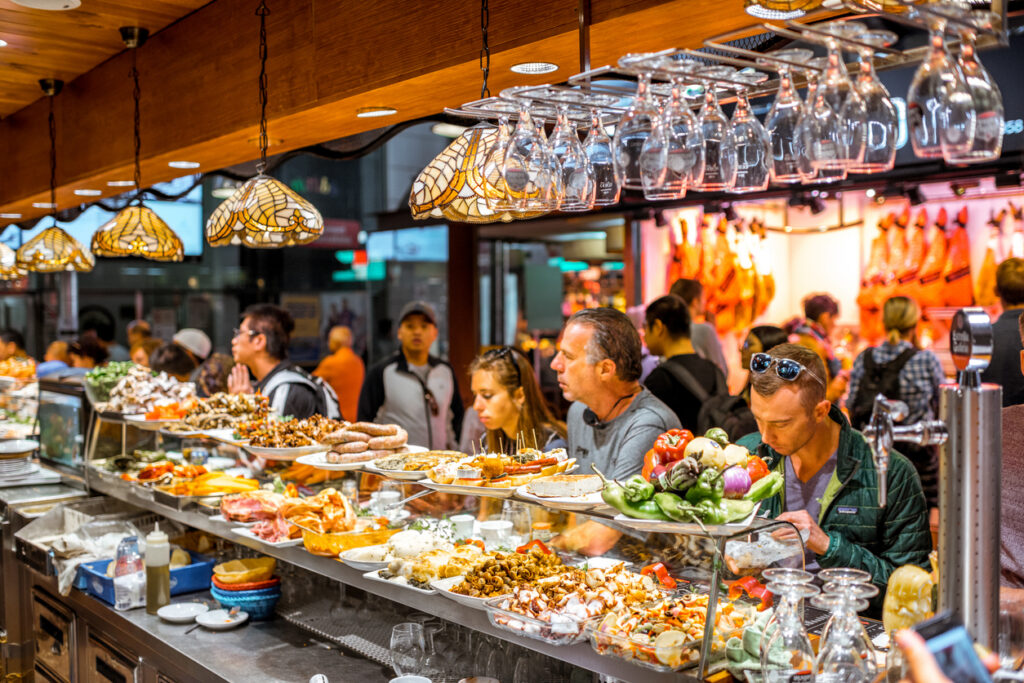
What Are Tapas, Exactly?
Tapas aren’t one particular type of food.
They’re small portions designed for sharing or eating alongside a drink. You might order a couple before dinner, make an entire meal by ordering several plates, or move between bars having one or two specialties at each.
That last approach is one of the most enjoyable ways to experience tapas in Barcelona.
Instead of finding one restaurant and ordering everything there, try a mini tapas crawl. Have vermouth and anchovies at one bar, croquettes somewhere else and finish with another small plate and a glass of wine.
You’ll also see different terms on Barcelona menus.
Tapa generally means a small portion.
Ración is a larger portion designed for sharing.
Platillo means a small plate.
Montadito is usually a small piece of bread topped with meat, seafood, cheese or another combination.
And then there are conservas, high-quality preserved foods, particularly seafood. Don’t make the mistake of thinking canned seafood is automatically cheap food. In Spain, excellent conservas can be a delicacy.
How to Recognize an Authentic Tapas Bar in Barcelona
There’s no foolproof test, and a restaurant isn’t automatically bad because tourists eat there.
Barcelona is one of Europe’s most visited cities. Plenty of excellent restaurants naturally attract visitors.
Instead, look at how the restaurant operates.
A short menu can be a very good sign. So can a bar specializing in only a handful of dishes.
Look for people stopping for vermouth, wine or beer with one or two small plates rather than restaurants aggressively trying to sell a complete “Spanish experience.”
You’ll often see dishes written on a chalkboard or menus built around seasonal products.
And don’t judge a place by how polished it looks.
Some of Barcelona’s most memorable tapas bars are tiny, crowded and decidedly unfancy.
If you’re researching where to find authentic tapas restaurants in Barcelona, don’t search exclusively for restaurants. Search for bodegas, vermuterías and neighborhood bars too.
That’s where things get interesting.
Poble-sec: One of Barcelona’s Best Areas for Tapas
Poble-sec is a great place to start a tapas crawl.
The neighborhood sits beneath Montjuïc and has a long tradition of small bars, bodegas and casual restaurants.
Carrer de Blai is particularly famous for tapas and pintxos. It’s pedestrian-friendly and lined with places where you can stop for a drink and small bite before moving on to the next bar.
But don’t limit yourself to Blai.
Walk into the surrounding streets and you’ll find one of Barcelona’s most famous tapas institutions.
Quimet & Quimet
Quimet & Quimet is the kind of place that challenges what tourists sometimes imagine a tapas restaurant should be.
It’s tiny. You eat standing up. There isn’t even a traditional kitchen.
Instead, the family-run bar specializes in high-quality conservas, cheeses, cured foods and elaborate montaditos assembled behind the counter.
The bar dates to 1914 and has remained in the same family for generations. Its walls are covered with bottles, and there’s very little room once the place fills up.
Try one of the seafood conservas or the famous montaditos. Combinations include salmon with yogurt and truffle honey, anchovies with cheese and other mixtures that sound unusual until you taste them.
Quimet & Quimet doesn’t accept reservations, so arriving around opening time can save you a considerable wait.
It’s no longer a secret neighborhood bar. Tourists know about it. Food writers know about it. Famous chefs know about it.
But its popularity hasn’t erased what makes the place special.
Barceloneta: Go for Seafood and the Bomba
Barceloneta‘s location beside the Mediterranean makes it an obvious destination for seafood.
Unfortunately, its location beside the beach also means there are plenty of restaurants catering almost exclusively to tourists.
So choose carefully.
Head away from the most obvious beachfront establishments and into the neighborhood’s narrow interior streets.
La Cova Fumada
For a completely different Barcelona food experience, try La Cova Fumada.
This family-run Barceloneta institution is about as no-frills as it gets.
The emphasis is on traditional food and fresh seafood rather than presentation. It’s busy, informal and sometimes chaotic, which is part of the experience.
One dish in particular makes it worth knowing: la bomba.
Barcelona’s official international welcome guide describes La Cova Fumada as an authentic Barceloneta hangout and credits it with inventing the bomba there in 1955.
A bomba is a fried ball of potato filled with meat and served with sauces. You’ll now find versions throughout Barcelona, but eating one in Barceloneta is particularly fitting.
Add a few seafood tapas and you’ve got a very Barcelona lunch.
El Born: Historic Barcelona With Excellent Tapas Stops
El Born is one of the easiest neighborhoods to incorporate into a sightseeing itinerary.
The Picasso Museum, Santa Maria del Mar and narrow medieval streets already bring visitors here.
Fortunately, there are also excellent places to eat.
El Xampanyet
Just steps from the Picasso Museum, El Xampanyet is an old-school cava and tapas bar with exactly the sort of lively atmosphere many travelers hope to find in Barcelona.
Expect people squeezed around tables and along the bar, bottles lining the walls and plenty of noise.
This isn’t where I’d go for a quiet romantic dinner.
It is where I’d go for cava, anchovies and a few tapas before continuing through El Born.
Bar del Pla
Nearby, Bar del Pla offers a slightly more contemporary interpretation of tapas while remaining grounded in Catalan flavors.
It’s a useful choice if you want the sharing-plate experience but prefer sitting down for a more relaxed meal.
The combination of traditional flavors and more creative small plates also makes it a good introduction for someone who’s new to Catalan food.
The Gothic Quarter: Yes, You Can Find Authentic Tapas Here
The Gothic Quarter presents a dilemma.
It’s one of Barcelona’s most tourist-heavy neighborhoods, but it’s also a real historic neighborhood with restaurants and bars that have been around far longer than modern mass tourism.
You don’t need to avoid the entire area.
You just need to choose carefully.
La Plata
La Plata is refreshingly simple.
It’s a tiny historic tapas bar known for a remarkably short menu of traditional dishes.
And that’s exactly the appeal.
Instead of trying to serve every Spanish dish a tourist might recognize, it sticks to a handful of specialties.
It’s an excellent reminder that authentic tapas culture doesn’t require 40 different choices.
Sometimes a few things done consistently well are enough.
La Vinateria del Call
Hidden in the narrow streets of Barcelona’s historic Jewish quarter, La Vinateria del Call combines Catalan tapas with a strong emphasis on wine.
The atmosphere is quieter and more intimate than some of the city’s famous standing-room tapas bars, making it a good option if you want traditional flavors without quite as much chaos.
Sant Antoni: Tapas and Vermouth Away From the Biggest Tourist Crowds
Sant Antoni has become increasingly popular with visitors, but it still feels more residential than the Gothic Quarter or the streets surrounding La Rambla.
It’s also an excellent neighborhood for vermouth.
The tradition of fer el vermut involves meeting before lunch for vermouth accompanied by snacks or small plates.
It’s worth trying at least once while you’re in Barcelona.
La Bodega d’en Rafel
La Bodega d’en Rafel has the feel of a traditional neighborhood bodega.
Expect classic Catalan and Spanish cooking rather than elaborate modern plating.
This is a particularly good neighborhood to wander without a rigid restaurant itinerary. Start around Mercat de Sant Antoni and explore the surrounding streets, stopping when somewhere looks promising.
Gràcia: Eat Where Barcelonans Live
If you’re still wondering where to find authentic tapas restaurants in Barcelona, get out of Ciutat Vella altogether.
Gràcia is one of the best neighborhoods for experiencing Barcelona beyond its biggest attractions.
The former village has its own plazas, neighborhood streets and strong local identity.
It’s filled with restaurants and bars but doesn’t feel like one continuous tourist district.
Bar Bodega Quimet
Don’t confuse this one with Quimet & Quimet in Poble-sec.
Bar Bodega Quimet is a traditional Gràcia bodega known for vermouth, local wine and classic small plates.
The small space and old-school tavern atmosphere make it a particularly good stop for an afternoon vermouth and a few tapas.
Gràcia is also an ideal neighborhood for wandering until you find somewhere that appeals to you.
Some of the most enjoyable meals in Barcelona happen when you stop trying to find a restaurant from a “Top 10 Barcelona Tapas” list and simply walk a few blocks away from the busiest streets.
What Tapas Should You Order in Barcelona?
Barcelona is in Catalonia, so don’t limit yourself to dishes you’ve heard described generically as “Spanish tapas.”
Look for Catalan specialties too.
Pa amb tomàquet is one of the simplest and most essential: bread rubbed with tomato and usually dressed with olive oil and salt.
Bombas are particularly associated with Barcelona and especially Barceloneta.
Croquetes can contain ham, chicken, mushrooms, seafood or other fillings.
Patatas bravas are fried potatoes typically served with a spicy sauce and often aioli.
Anxoves are anchovies, something Barcelona does extremely well.
Boquerones are anchovies typically marinated in vinegar.
Calamars and other seafood are natural choices given Barcelona’s Mediterranean location.
Escalivada combines roasted vegetables, traditionally peppers and eggplant.
Truita de patates is the Catalan name for Spanish potato omelet.
And if you see high-quality conservas, don’t dismiss them. Tinned mussels, cockles, razor clams, sardines and tuna can be some of the best things on the menu.
What Should You Drink With Tapas?
Wine and beer are obvious options, but try vermouth.
Barcelona has a strong vermouth culture, particularly around the traditional pre-lunch vermut.
Order un vermut and see what arrives.
Cava is another natural choice, especially at bars specializing in it.
And while sangria is available everywhere in Barcelona, don’t assume that’s what locals traditionally drink every time they eat tapas.
If you’re at a small bodega, look at what everyone around you is drinking.
That’s often your best clue.
Should You Eat Tapas on La Rambla?
You can, but I wouldn’t make La Rambla the center of a food-focused Barcelona itinerary.
The street receives enormous numbers of visitors, and restaurants in the most heavily trafficked areas don’t have the same incentive to cultivate repeat neighborhood customers.
That doesn’t mean every restaurant near La Rambla is bad.
It means you have much more interesting choices a short walk away.
Walk toward the Gothic Quarter, Raval or Sant Antoni. Or take the Metro to Poble-sec or Gràcia.
If your goal is figuring out where to find authentic tapas restaurants in Barcelona, exploring beyond the most obvious tourist corridor dramatically increases your options.
How to Do Your Own Barcelona Tapas Crawl
Don’t over-plan it.
Choose one neighborhood and pick three places within walking distance.
At the first bar, order a drink and one or two tapas.
Then move on.
At the second, try something completely different.
Finish at the third with another dish or dessert.
Poble-sec works particularly well for this, as do El Born, Gràcia and Sant Antoni.
The point isn’t to consume an enormous dinner at three restaurants.
It’s to experience the social rhythm of moving between bars.
Two people might share one or two plates at each stop and slowly turn an evening into dinner.
That’s much closer to the spirit of tapas than sitting down and ordering 12 dishes simultaneously because you feel like you’re supposed to try everything.
Don’t Be Afraid of a Crowded Bar
For travelers accustomed to restaurants where everyone waits to be seated, Barcelona’s traditional bar culture can initially feel confusing.
You may walk into a tiny place and wonder where you’re supposed to stand, whether someone will take your order or whether you’ve somehow missed the host.
There may not be a host.
Watch what other people are doing.
Approach the bar when you can, order a drink and ask about food.
Some places are chaotic. That’s okay.
A crowded room with people drinking vermouth and sharing plates isn’t necessarily a sign you should leave.
It might be a sign you’ve found exactly what you were looking for.
Frequently Asked Questions About Tapas in Barcelona
What is the best street in Barcelona for tapas?
Carrer de Blai in Poble-sec is one of Barcelona’s best-known streets for a tapas and pintxos crawl. The pedestrian street and surrounding Poble-sec neighborhood contain numerous small bars within easy walking distance of one another. For a more traditional experience, explore the streets surrounding Blai as well rather than limiting yourself to the main strip.
Where is the best place to eat tapas in Barcelona?
Poble-sec, Barceloneta, El Born, Sant Antoni, the Gothic Quarter and Gràcia are all excellent areas for tapas in Barcelona. For specific traditional experiences, try Quimet & Quimet in Poble-sec, La Cova Fumada in Barceloneta, or El Xampanyet in El Born. The best choice depends on whether you want seafood, a traditional bodega, modern tapas or a bar crawl.
What is Anthony Bourdain’s favorite restaurant in Barcelona?
There isn’t a well-documented single Barcelona restaurant that Anthony Bourdain definitively named as his favorite. He visited and praised multiple Barcelona food destinations during his television career. Quimet & Quimet is frequently associated with Bourdain and local reporting confirms that he visited the century-old Poble-sec bar, while his Barcelona television appearances also included other restaurants and culinary destinations.
What is a must eat in Barcelona, Spain?
Must-eat foods in Barcelona include pa amb tomàquet, bombas, patatas bravas, croquettes, anchovies, seafood, escalivada and Catalan-style dishes made with seasonal ingredients. For something particularly connected to Barcelona, try a bomba in Barceloneta. La Cova Fumada is traditionally credited with creating the potato-and-meat tapa in 1955.
Final Thoughts: Where to Find Authentic Tapas Restaurants in Barcelona
The best tapas experience in Barcelona isn’t necessarily the restaurant with the fanciest dining room, the longest menu or the biggest social media following.
Sometimes it’s a tiny bodega with four dishes.
Sometimes it’s standing shoulder-to-shoulder with strangers eating anchovies and drinking vermouth.
Sometimes it’s fresh seafood in Barceloneta or a plate of croquettes at a neighborhood bar in Gràcia.
If you want to know where to find authentic tapas restaurants in Barcelona, start with the neighborhoods rather than a list of famous restaurant names.
Explore Poble-sec, Barceloneta, El Born, Sant Antoni, Gràcia and the quieter corners of the Gothic Quarter. Look for places specializing in a few things rather than trying to serve every Spanish dish imaginable.
And don’t feel like you need to find one “best tapas restaurant.”
Have one tapa. Have a drink. Walk down the street and do it again.
That’s half the fun.
Further Reading
- Barcelona Travel Guide 2024.
- Unlock Hidden Gems: A Guide to the Best Nightlife in Barcelona
- Bite-Size Barcelona: A Foodie’s Adventure into the World of Tapas
- the Ultimate Bucket List: Top Things to Do in Barcelona
- Girona and the Game of Thrones
- Best Hotels in Barcelona’s Gothic Quarter: Luxury to Budget
- Why You Need to Visit Girona, Spain’s Fairytale City
- Pack Like a Pro: The Ultimate Europe Packing List
- How to Plan the Perfect Trip to Europe: Tips and Tools
- Barcelona in February: A Guide to the City in Winter
- How to Visit Valencia Like a Local
- Best Nightclubs in Barcelona



Be the first to comment