


Airbnb vs Hotel Spain: Which Should You Choose for Your Trip?
Most travelers treat the Airbnb vs hotel Spain decision as a simple preference. More space or more service. Local feel or convenience.
But in Spain, that choice has a bigger impact than you might expect.
Where you stay affects how easily you move through a city, how much time you lose to logistics, and how your days actually unfold. It’s not just about the room—it’s about how your trip works.
If you’ve ever dealt with a delayed check-in, struggled to find your apartment in a maze of narrow streets, or wished you could just drop your bags and move on, you already understand why this matters.
This guide breaks down Airbnb vs hotel Spain with a focus on what actually improves your trip—not just what sounds appealing when you’re booking.
Some links are affiliate links, which means I may earn a small commission at no extra cost to you—I only recommend places I genuinely think you’ll love and that are worth your time.
Airbnb vs Hotel Spain: Quick Answer
If you want a straightforward answer:
- Choose hotels for shorter stays, city-hopping trips, and convenience
- Choose Airbnb for longer stays, slower travel, and more space
This simplified framework works well as a starting point, but it only holds if your trip aligns with how each option functions in practice. The details—timing, location, and travel pace—are what ultimately determine whether this choice helps or complicates your trip.
Why the Airbnb vs Hotel Spain Decision Matters More Than You Think
Spain rewards efficient planning. Cities are walkable, but they require energy—especially in the heat or when you’re navigating crowded areas.
This is where accommodation starts to shape your experience.
What changes depending on where you stay:
- Time lost to coordination
Airbnb check-ins often require scheduling. Hotels don’t. - Daily flow
Hotels simplify mornings and evenings. Airbnb can add small tasks that build up. - Noise and rest
Central Spanish streets stay active late. Hotels are usually better insulated. - Support when something goes wrong
Hotels resolve issues quickly. Airbnb depends on host response time.
These differences seem small when you’re booking, but they compound once you’re traveling. In the Airbnb vs hotel Spain decision, reducing friction often leads to a noticeably smoother trip.
Learn more about Spain travel here
When Airbnb in Spain Is the Better Choice
Airbnb can work well—but it works best under specific conditions.
Airbnb is a good fit if:
- You’re staying at least 3–4 nights in one place
- You want space to spread out
- You prefer a slower, less structured itinerary
- You’re traveling with family or a group
Where Airbnb works best:
- Residential neighborhoods in Madrid (like Chamberí)
- Valencia outside the historic center
- Smaller towns like Cádiz or coastal areas
What you gain:
- More room to relax
- Kitchen access (useful for breakfast or light meals)
- A quieter, residential feel
What to watch for:
- Check-in coordination
- Cleaning expectations
- Limited on-site support
Airbnb tends to work best when your trip has built-in flexibility. If your days are loosely planned and you’re not rushing between activities, the added space can improve your experience.
When Hotels in Spain Are the Better Option
Hotels tend to be the more reliable choice—especially if your trip includes multiple cities.
Hotels are a better fit if:
- You’re staying 1–2 nights per city
- You’re arriving late or leaving early
- You want a consistent, predictable experience
- You’re staying in central, high-traffic areas
Where hotels perform better:
- Madrid city center (Sol, Gran Vía)
- Barcelona (Eixample, El Born)
- Seville historic center
What hotels do better:
- 24-hour reception
- Luggage storage
- Daily cleaning
- Faster issue resolution
Hotels reduce the number of decisions you have to make during your trip. In the Airbnb vs hotel Spain comparison, that simplicity is often what makes the difference.
Airbnb vs Hotel Spain: Cost Comparison
One of the biggest misconceptions is that Airbnb is always cheaper.
In Spain, that’s often not the case.
What affects Airbnb pricing:
- Cleaning fees
- Service fees
- Minimum stay requirements
What affects hotel pricing:
- Seasonality
- Location
- Room type
Realistic comparison:
Airbnb (2 nights in Barcelona):
- €120 per night
- €60 cleaning fee
- €40 service fee
- Total: €340
Hotel (same area):
- €150 per night
- No extra fees
- Total: €300
When Airbnb is more cost-effective:
- Stays of 4+ nights
- Group travel
- Smaller cities with lower demand
Pricing alone doesn’t determine value. In the Airbnb vs hotel Spain decision, convenience and time saved often offset small cost differences.
Location: The Factor That Changes Everything
Location is where most travelers make the wrong decision.
Common Airbnb issues:
- Listings labeled “central” that are 15–20 minutes away
- Limited access to public transport
- Difficult walking routes (especially in older neighborhoods)
What hotels usually get right:
- Proximity to transit
- Walkability
- Easier late-night access
What works better:
- Stay within walking distance of key areas
- Prioritize metro access if not central
- Check actual walking routes, not just map pins
In Spain, location directly affects how much you enjoy your day. In the Airbnb vs hotel Spain decision, a slightly smaller hotel in the right location often outperforms a larger Airbnb that’s less convenient.
Experience vs Convenience: What Do You Actually Want?
This is where expectations need to be adjusted.
Airbnb expectations:
- Living like a local
- Cooking meals
- Slower, more immersive travel
The reality in Spain:
- Restaurants are central to daily life
- Grocery shopping can take time
- Short stays limit how immersive the experience feels
Hotel reality:
- Less space
- Less personalization
- More efficiency
A more useful way to think about it:
- Choose Airbnb if you want your accommodation to be part of your experience
- Choose a hotel if you want your accommodation to support your experience
Clarity here makes the Airbnb vs hotel Spain decision much easier. Most trips benefit more from support than immersion.
The Controversy Around Airbnb in Spain
In recent years, short-term rentals have become a point of tension in many Spanish cities.
Local governments and residents have raised concerns about how Airbnb affects housing availability, rental prices, and neighborhood dynamics—particularly in cities like Barcelona and Madrid.
Key concerns:
- Reduction of long-term housing for residents
- Rising rental prices in central neighborhoods
- Increased tourism pressure in residential areas
As a result, some cities have introduced stricter regulations, limiting new licenses and enforcing compliance more actively.
Read more about Airbnb impacts here
What this means for travelers:
Choosing a hotel is often the more straightforward and socially responsible option—especially in high-demand urban areas. Hotels operate within established regulations and don’t contribute to the same level of housing displacement.
That doesn’t mean Airbnb should always be avoided. In smaller towns or less saturated areas, it can still be a reasonable choice. But in major cities, the Airbnb vs hotel Spain decision now includes a broader impact beyond your own trip.

City-by-City Breakdown
Not all destinations in Spain function the same way. The Airbnb vs hotel Spain decision shifts depending on layout, regulations, and how people actually move through each city. What works well in one place can create unnecessary friction in another.
Barcelona
Barcelona is one of the most regulated cities in Spain when it comes to short-term rentals, and that has changed the Airbnb landscape significantly. Many listings operate under strict licensing rules, and availability in central areas is more limited than it appears at first glance.
- Strict Airbnb regulations
- Older buildings with noise concerns
- Strong hotel infrastructure
In practice, many Airbnb options are located in older buildings without sound insulation or elevators. This matters more than expected—especially in neighborhoods like El Born or the Gothic Quarter, where street noise carries late into the night. Hotels, particularly in Eixample, tend to offer better layout, easier access, and more predictable comfort.
Best choice: Hotel for most trips
Read more about where to stay in Barcelona
Madrid
Madrid offers one of the most balanced accommodation landscapes in Spain. You’ll find strong hotel options across all budgets, but Airbnb can work well if you choose the right neighborhood.
- Balanced accommodation options
- Airbnb works well in residential areas
The key distinction in Madrid is location. Airbnb tends to perform better outside the most crowded areas—neighborhoods like Chamberí, Salamanca, or La Latina—where you get more space without sacrificing access. Hotels, on the other hand, are often better positioned for short stays in central areas like Sol or Gran Vía.
Best choice: Depends on location
Read more about where to stay in Madrid
Seville
Seville is compact, walkable, and relatively easy to navigate, which reduces the need for extra space or flexibility in your accommodation.
- Compact layout
- Strong boutique hotel options
The city also has a high concentration of smaller boutique hotels, many of which are set in restored historic buildings. These often provide more character than a standard hotel while still offering the convenience of reception, cleaning, and central access. Airbnb options exist, but they don’t offer a clear advantage for shorter stays.
Best choice: Hotel
Read more about where to stay in Sevilla
Granada
Granada is where terrain becomes a deciding factor. The city’s most atmospheric neighborhoods—like the Albaicín—are also the most difficult to navigate.
- Steep terrain in historic areas
- Airbnb locations can be difficult to access
Many Airbnb listings are located on narrow, uphill streets that are not easily accessible by taxi. Carrying luggage through these areas can be more challenging than expected. Hotels, particularly those closer to the city center or lower Albaicín, tend to offer easier access while still keeping you close to key sights.
Best choice: Choose carefully
Read more about where to stay in Granada
Coastal Towns (Cádiz, San Sebastián)
Coastal destinations function differently from major cities. Travel tends to slow down, and accommodation becomes more about comfort and space than constant movement.
- Airbnb works well for longer stays
- Hotels fill quickly in peak season
In places like Cádiz or San Sebastián, Airbnb can work well if you’re staying several days and want room to settle in. These cities are smaller, and daily logistics are simpler, which makes the added space more useful. However, during peak summer months, hotel availability becomes limited quickly, and prices increase.
Best choice: Airbnb for extended visits
Each destination shifts the balance slightly, which is why the Airbnb vs hotel Spain decision should be made city by city—not applied the same way across your entire itinerary.
Important Note for Families of Four
One practical issue that often gets overlooked in the Airbnb vs hotel Spain decision is how hotels handle family occupancy.
Many hotels in Spain are designed for 2–3 guests per room. For a family of four, this often means:
- Booking two separate rooms
- Paying significantly more than expected
- Losing the convenience of being in one shared space
This is where Airbnb can have a clear advantage—but it’s not the only solution.
What to book instead (better options for families):
- Apartment-style hotels (aparthotels)
These offer hotel services with apartment layouts—usually including a living area and multiple beds. - Family rooms or suites
Some hotels do offer larger rooms, but they’re limited and should be booked early. - Connected rooms
A more common workaround, though it still splits your space. - Boutique or smaller hotels
These sometimes have more flexible room configurations than large chains.
When Airbnb makes sense for families:
- You want everyone in one space
- You’re staying multiple nights
- You don’t want to manage multiple hotel bookings
Trade-off to consider:
You gain space and simplicity for your group—but you may lose the ease and support that hotels provide.
For families, the Airbnb vs hotel Spain decision often comes down to whether shared space or convenience matters more for your trip.
Common Mistakes to Avoid
Airbnb mistakes:
- Booking based on photos instead of location
- Underestimating coordination requirements
- Ignoring potential noise
Hotel mistakes:
- Overpaying for amenities you won’t use
- Choosing convenience without checking neighborhood quality
Most issues come from mismatched expectations. The more your choice aligns with how you actually travel, the better your experience will be.
Pros and Cons: Airbnb vs Hotel Spain
Airbnb Pros:
- More space
- Better for groups
- Suitable for longer stays
Airbnb Cons:
- More coordination required
- Less immediate support
- Inconsistent quality
Hotel Pros:
- Easy check-in
- Reliable experience
- Central locations
Hotel Cons:
- Smaller rooms
- Less flexibility
- Higher cost over longer stays
These trade-offs are consistent across most cities, which makes them a useful baseline when deciding between Airbnb vs hotel Spain.
Final Decision Guide
If you want a clear way to decide:
Choose Airbnb if:
- You’re staying 3+ nights
- You want space and flexibility
- You’re comfortable handling logistics
Choose a hotel if:
- You’re moving between cities
- You want a smoother experience
- You value convenience and time
This approach keeps the Airbnb vs hotel Spain decision focused and practical.
Conclusion: Airbnb vs Hotel Spain
Spain is easy to enjoy—but significantly better when your logistics are working in your favor.
The Airbnb vs hotel Spain choice isn’t about which option is better overall. It’s about which one fits how your trip actually functions.
Airbnb can work well for longer, slower stays where space matters. Hotels tend to work better for structured trips where time, ease, and consistency are priorities.
If you’re unsure, choose the option that removes friction. It usually leads to a better experience—and, increasingly, a more responsible one as well.
FAQs: Airbnb vs Hotel Spain
Should I use Airbnb in Spain?
Airbnb can work well in Spain if you are staying at least 3–4 nights in one place, want more space, or are traveling with a group. It is less ideal for short stays or city-hopping trips where check-in coordination and logistics can slow you down. For most first-time trips, hotels tend to be the easier option.
What is the 80/20 rule for Airbnb?
The 80/20 rule for Airbnb means that about 80% of your experience comes from 20% of factors—usually location, host reliability, and building quality. In Spain, this is especially important. A well-located Airbnb in a quiet, accessible building will outperform a larger but poorly located option every time.
Why is Spain against Airbnb?
Spain is not universally against Airbnb, but many cities have introduced restrictions due to housing pressure and tourism impact. Short-term rentals can reduce long-term housing availability and increase rental prices in central neighborhoods. Cities like Barcelona and Madrid have responded with licensing rules and enforcement measures to manage this.
Is it better to stay in a hotel or Airbnb in Madrid?
It depends on your trip style. Hotels are better for short stays, central locations, and convenience. Airbnb works well in residential neighborhoods if you want more space and are staying longer. For most travelers visiting Madrid for the first time, a centrally located hotel is the more practical choice.
Disclaimer: This content is for informational purposes only and is based on personal research and opinion. While I aim to provide accurate and up-to-date information, travel details such as pricing, availability, and policies can change at any time. You should always do your own research and verify details directly with hotels or providers before booking. I am not responsible for any decisions made, experiences, losses, or issues that may arise from using this information.
Barcelona Hotels
Experience luxury and style in Barcelona with stays at H10 Montcada Boutique Hotel, offering chic, centrally-located accommodations; Hilton Diagonal Mar Barcelona, known for its luxurious rooms and proximity to the beach; Hotel 1898, which exudes historical elegance on the famous Las Ramblas; and Hotel Colón, a prime spot facing the Barcelona Cathedral with beautifully appointed rooms.

Hotel Sercotel Rosellon
Hotel Sercotel Rosellon offers modern accommodations with stunning views of the Sagrada Familia in the heart of Barcelona.

Hotel Ohla Barcelona
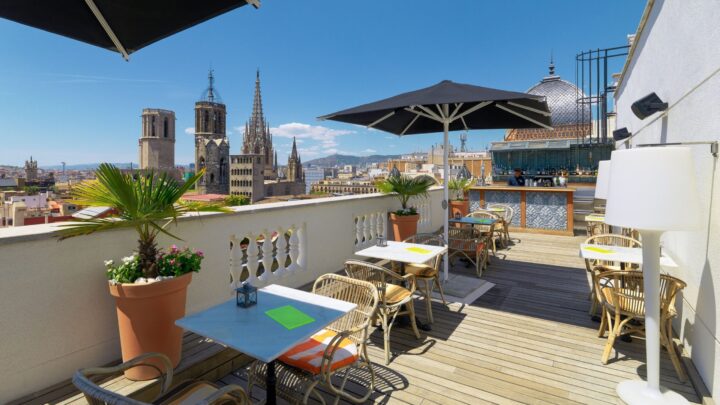
Hotel Ohla Barcelona is a luxurious boutique hotel located in the city's Gothic Quarter, renowned for its contemporary design, rooftop terrace with panoramic views, and exceptional dining experiences.



Hilton Diagonal Mar Barcelona
The Hilton Diagonal Mar Barcelona offers luxurious accommodations with stunning views, conveniently located near the beach and Barcelona's vibrant city center.



Comments Off on Airbnb vs Hotel Spain: Which Is Better for Your Trip?